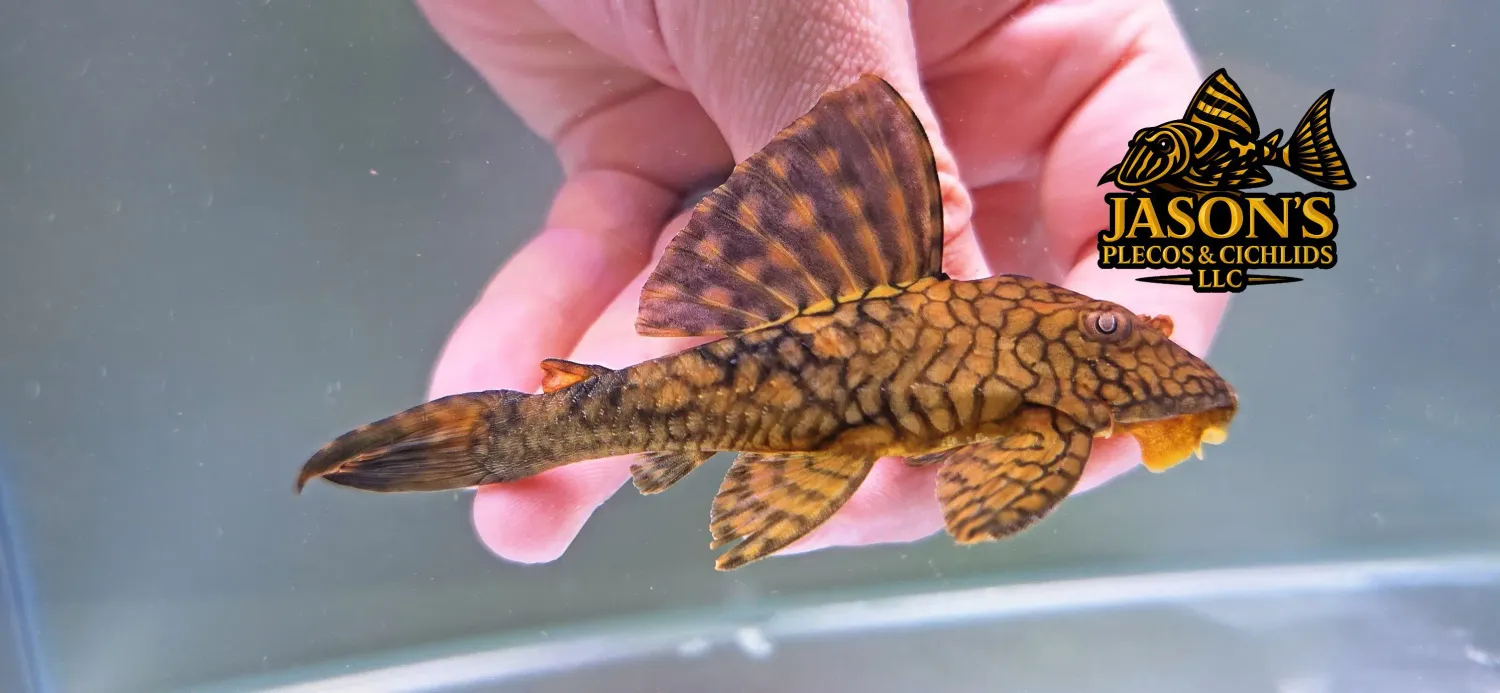
L037 Honeycomb Pleco - (Hypostomus faveolus)
$45.00
Sold out
was $50.00 Save 10%
Size
Questions, Comments, Concerns? Let us know!
Enter your text
Price of shipping is not included.
Sold out
Save this fish to my favorites.
Customer reviews
Reviews only from verified customers
No reviews yet. You can buy this product and be the first to leave a review.
L037 Honeycomb Pleco - (Hypostomus faveolus)
Fish Details, Description and Information Below:
🐟 L037 Honeycomb Pleco – (Hypostomus faveolus) – Wild-Caught Brazilian Honeycomb Pleco
The L037 Honeycomb Pleco (Hypostomus faveolus) is a distinctive Brazilian pleco known for its unusual honeycomb-like pattern of pale tan, yellow-brown, or cream-colored blotches separated by thin dark lines.
Unlike plecos covered in simple dots or stripes, the L037 develops an intricate reticulated pattern that can resemble:
- 🍯 Honeycomb
- 🕸️ Netting
- 🧩 Irregular geometric shapes
- 🐆 Connected blotches
This unique coloration is so characteristic that it inspired the scientific species name:
faveolus
which refers to a honeycomb-like pattern.
The Honeycomb Pleco is a medium-sized member of the genus Hypostomus. It does not reach the enormous size of many Common Plecos or Sailfin Plecos, but mature specimens can still approach approximately 8–10 inches total length and require a spacious aquarium with strong filtration and adequate bottom territory.
Wild Hypostomus faveolus occur in Brazil's Rio Tocantins/Araguaia and upper Rio Xingu systems, inhabiting everything from rocky rapids to slower sections of medium and large rivers.
They are adaptable omnivorous grazers that should receive a varied diet containing substantial:
- Algae-based foods
- Vegetable matter
- Biofilm
- Quality sinking pellets
along with appropriate supplemental animal and insect protein.
The species has also been successfully bred in captivity, with documented males guarding egg clutches inside caves.
This listing is for:
WILD-CAUGHT L037 HONEYCOMB PLECOS
🔎 Quick Facts – L037 Honeycomb Pleco
- 📛 Common Name: Honeycomb Pleco
- 📛 Other Name: Faveolus Pleco
- 🔢 L-Number: L037
- 🔬 Scientific Name: Hypostomus faveolus
- 🐟 Family: Loricariidae
- 🧬 Subfamily: Hypostominae
- 🌿 Stock: Wild Caught
- 🇧🇷 Country: Brazil
- 🌊 Primary Native Range: Rio Tocantins / Araguaia and Upper Rio Xingu Basins
- 🌎 Broader Species Distribution: Current taxonomic records also include the upper Paraná drainage
- 💧 Water Type: Freshwater
- 📏 Scientific Maximum: Approximately 20.6 cm / 8.1 inches standard length
- 📏 Adult Planning Size: Approximately 8–10 inches total length
- 🏠 Recommended Aquarium: 75 gallons or larger
- 👥 Multiple Plecos: 90+ gallons with adequate shelters and bottom territory
- 🌡️ Temperature: Approximately 75–82°F
- 💧 pH: Approximately 6.0–7.5
- 💦 Hardness: Soft to moderately hard
- 💨 Oxygenation: Good to High
- 🌊 Water Movement: Moderate with stronger-flow areas
- 🍽️ Diet: Omnivorous Grazer with Strong Plant / Algae Component
- 🌿 Vegetable Foods: Important
- 🦐 Animal Protein: Supplemental
- 😌 Temperament: Generally peaceful; territorial behavior may occur around shelters
- 🌙 Activity: Primarily nocturnal / crepuscular
- 🐠 Swimming Area: Bottom
- 🥚 Breeding: Cave Spawner
- 👨👩👧 Parental Care: Male guards eggs and fry
- ⭐ Care Level: Intermediate
- 🌎 Conservation Status: Least Concern
🍯 Why Is It Called the Honeycomb Pleco?
The name:
Honeycomb Pleco
comes directly from the species' unusual body pattern.
Rather than simple round spots, the fish develops:
Pale Blotches Surrounded by Thin Dark Borders
These markings form interconnected shapes resembling:
A Honeycomb
The pattern can cover:
- Head
- Body
- Dorsal fin
- Pectoral fins
- Pelvic fins
- Caudal fin
making the entire fish appear covered in a network of irregular cells.
🧬 Meaning of the Scientific Name
The scientific species name:
faveolus
comes from Latin terminology related to:
favus – honeycomb
and refers directly to the fish's distinctive pattern.
Few plecos have a scientific name that describes their appearance as clearly as this species.
🧬 A Formally Described Species
L037 originally entered the aquarium hobby before scientists formally described it.
For years it was known simply as:
Hypostomus sp. L037
In:
2008
it was formally described as:
Hypostomus faveolus
by:
- Cláudio H. Zawadzki
- José L. O. Birindelli
- Flávio C. T. Lima
Therefore, the correct modern product identification is:
L037 Honeycomb Pleco – (Hypostomus faveolus)
🗺️ Type Locality
The type locality of Hypostomus faveolus is in:
Mato Grosso, Brazil
within the:
Rio Araguaia Drainage
which is part of the larger:
Rio Tocantins Basin
The original type locality is near:
Cocalinho, Mato Grosso
🌎 Natural Distribution
The species is naturally associated with several Brazilian river systems.
Important populations occur in the:
- Rio Tocantins Basin
- Rio Araguaia Drainage
- Upper Rio Xingu Basin
Current taxonomic records also include:
- Upper Paraná Drainage
However, the aquarium L037 form is most strongly associated with Brazilian Tocantins/Araguaia and Xingu fish.
🎨 Geographic Color Variation
One particularly interesting feature of Hypostomus faveolus is that its pattern can vary according to locality.
Fish from the:
Rio Xingu
often display somewhat broader dark borders around the pale blotches.
Fish from the:
Rio Tocantins / Araguaia
may display slightly different proportions between the light blotches and dark borders.
Juveniles can also show different patterns depending on collection locality.
⚠️ Pattern Can Vary
No two L037 Honeycomb Plecos should be expected to look exactly alike.
Individual differences may include:
- Size of the honeycomb pattern
- Width of dark borders
- Number of pale blotches
- Body darkness
- Fin coloration
- Contrast
Appearance can also temporarily change because of:
- Stress
- Shipping
- Aquarium background
- Lighting
- Diet
- Water conditions
- Acclimation
🛡️ Armored Appearance
Like other Loricariidae, the Honeycomb Pleco is protected by rows of:
Bony Plates
rather than ordinary fish scales.
The species also has noticeable:
- Body keels
- Head ridges
- Predorsal ridges
- Strong pectoral-fin rays
These features give mature specimens a heavily armored appearance.
📏 Adult Size
FishBase currently documents Hypostomus faveolus reaching:
20.6 cm / approximately 8.1 inches STANDARD LENGTH
Standard length does:
NOT INCLUDE THE TAIL FIN
Therefore, a full-grown specimen may approach approximately:
8–10 Inches Total Length
depending on the individual.
This makes L037 substantially more manageable than many Hypostomus and Pterygoplichthys species that can exceed 18–24 inches.
⚠️ Not a Tiny Pleco
Although smaller than a Common Pleco, L037 is still a substantial fish.
Do not plan permanent housing around the size of a:
- 2-inch juvenile
- 3-inch juvenile
- 4-inch juvenile
A mature Honeycomb Pleco becomes:
- Thick-bodied
- Heavily armored
- Strong
- Territorial around preferred shelters
- A significant waste producer
🏠 Aquarium Size
For one adult L037 Honeycomb Pleco:
75 Gallons or Larger
is recommended.
This provides:
- Better bottom area
- Greater water stability
- Additional shelter
- More feeding territory
- Better dilution of waste
For multiple Honeycomb Plecos or other substantial bottom dwellers:
90 Gallons or Larger
is preferable.
📐 Aquarium Footprint Matters
Because this species spends most of its life near the bottom:
Length and Width Matter More Than Excessive Height
A long aquarium allows more room for:
- Multiple shelters
- Separate feeding areas
- Rockwork
- Driftwood
- Territories
and reduces competition between bottom-dwelling fish.
🌊 Natural Habitat
One interesting feature of this species is its ability to use several different river habitats.
Adults have been found in:
Rocky Rapids
but also in:
Slower-Flowing Sections of Medium and Large Rivers
They may occur over:
- Rock
- Gravel
- Sand
- Softer substrate
Juveniles have even been documented in:
- Small streams
- Oxbow lakes
This means L037 is more adaptable than a pleco restricted exclusively to violent rapids.
🌊 Aquarium Flow
The aquarium should provide:
Moderate Water Movement
with some stronger-flow areas.
However:
The entire aquarium does not need to be an extreme torrent.
A good layout provides:
🌊 Higher-Flow Areas
for:
- Oxygenation
- Grazing
- Natural behavior
and:
🪨 Lower-Flow Shelters
where the fish can:
- Rest
- Hide
- Establish territory
💨 Oxygenation
Strong oxygenation is still important.
Recommended methods include:
- Strong surface agitation
- Efficient filter returns
- Air stones
- Powerheads
- Circulation pumps
- Sump filtration
Maintain:
Clean, Oxygen-Rich Water
especially at warmer temperatures.
🪨 Aquarium Setup
A suitable L037 aquarium should include:
- Smooth rocks
- Rock structures
- Driftwood
- Large caves
- Sand or smooth gravel
- Shaded resting areas
- Open feeding surfaces
- Strong filtration
- Good circulation
- High oxygenation
Provide enough structure for the fish to completely retreat from view when desired.
🏠 Caves & Shelters
Honeycomb Plecos appreciate secure shelter.
Suitable options include:
- Ceramic pleco caves
- Slate caves
- Large rock crevices
- Driftwood shelters
- PVC-style breeding tubes
When multiple plecos are housed together:
Provide More Shelters Than Fish
This reduces competition over favorite hiding areas.
🪵 Driftwood
Driftwood is highly useful in an L037 aquarium.
It provides:
- Shelter
- Shade
- Biofilm
- Grazing surfaces
- Territory boundaries
However:
L037 Is Not a Specialized Wood-Eating Pleco
Unlike species in genera such as:
- Panaque
- Panaqolus
the Honeycomb Pleco does not require wood as a major dietary component.
Wood is excellent:
Habitat and Enrichment
but should not be described as essential for digestion.
💧 Water Parameters
A practical long-term aquarium range is:
- 🌡️ Temperature: 75–82°F
- 💧 pH: Approximately 6.0–7.5
- 💦 Hardness: Soft to moderately hard
- 💨 Oxygenation: Good to High
- 🌊 Flow: Moderate
- ☠️ Ammonia: 0 ppm
- ☠️ Nitrite: 0 ppm
- 🔄 Nitrate: Keep as low as reasonably practical
The species has also been successfully bred outside an extremely narrow water-chemistry range, demonstrating that:
Stability and Water Quality Are More Important Than Chasing One Exact Number
💩 Filtration
A mature L037 produces substantially more waste than a tiny decorative pleco.
Strong filtration is recommended.
Suitable filtration may include:
- Large canister filters
- Sump filtration
- High-capacity biological filtration
- Strong mechanical filtration
- Supplemental sponge filtration
- Strong surface agitation
Regular partial water changes should be part of routine care.
🍽️ Diet – Omnivorous Grazer
The Honeycomb Pleco is best described as an:
Omnivorous Grazer With a Strong Plant / Algae Component
It consumes a broad variety of foods.
A proper captive diet should not consist exclusively of either:
- Vegetables
or:
- Meat
🌿 Plant-Based Foods
Suitable foods include:
- High-quality algae wafers
- Spirulina wafers
- Vegetable-based sinking pellets
- Zucchini
- Squash
- Cucumber
- Green beans
- Spinach
- Kale
- Other appropriate vegetables
Plant-based nutrition should form an important part of the diet.
🦐 Supplemental Protein
Appropriate supplemental protein may include:
- Mysis shrimp
- Brine shrimp
- Bloodworms
- Krill
- Insect-based foods
- Shrimp-based sinking foods
- Quality omnivore pellets
Protein should supplement the overall diet rather than completely replace plant-based foods.
🍂 Natural Grazing Behavior
Honeycomb Plecos will also graze:
- Algae
- Biofilm
- Organic coatings
- Natural surfaces
- Soft decaying plant material
A mature aquarium with natural biofilm provides useful additional feeding opportunities.
🚫 Not Just an Aquarium Cleaner
Although L037 may consume algae:
It should not be purchased simply to clean an aquarium.
The fish still needs:
- Regular feeding
- Quality prepared foods
- Vegetables
- Appropriate protein
Aquarium algae alone is not a complete diet.
🌙 Nocturnal Behavior
The Honeycomb Pleco is primarily:
Nocturnal / Crepuscular
Activity generally increases:
- At dusk
- After the lights go out
- During feeding
- Under subdued lighting
Newly imported fish may remain hidden during the day.
Established specimens often become increasingly confident and may eventually feed while the aquarium lights are on.
🧪 Wild-Caught Acclimation
Because this listing is for:
WILD-CAUGHT L037 HONEYCOMB PLECOS
careful acclimation is important.
After arrival:
- Provide immediate shelter
- Maintain good oxygenation
- Keep lighting subdued
- Avoid sudden parameter changes
- Monitor respiration
- Monitor feeding
- Watch body condition
- Maintain excellent water quality
Wild-caught plecos may initially require extra time to become comfortable with prepared aquarium foods.
🍽️ Make Sure the Pleco Is Eating
In a community aquarium, faster fish can consume most food before the pleco emerges.
Offer some food:
- Near its shelter
- After lights out
- In several different locations
Watch for:
- Sunken abdomen
- Loss of body mass
- Persistent hiding combined with refusal to eat
A wild-caught pleco should be monitored carefully until regular feeding is confirmed.
😌 Temperament
Toward most appropriately sized midwater fish, the Honeycomb Pleco is generally:
Peaceful
It can make a good bottom-dwelling companion for suitable community or larger South American aquariums.
However:
Pleco-to-Pleco Territorial Behavior Can Occur
⚠️ Territorial Behavior
Adults may defend:
- Preferred caves
- Feeding areas
- Driftwood
- Rock shelters
Conflicts can involve:
- Chasing
- Pushing
- Tail slapping
- Blocking cave entrances
Provide sufficient:
- Bottom space
- Visual barriers
- Feeding locations
- Shelters
when multiple plecos are present.
👥 Social Behavior
L037 appears more tolerant of its own species than many extremely territorial cactus plecos.
Captive breeders have successfully maintained breeding groups.
However:
Tolerance Does Not Mean Unlimited Crowding
Adequate territory remains necessary.
🐠 Tankmates
Potential tankmates may include appropriately sized:
- Tetras
- Rainbowfish
- Barbs
- Geophagus
- Severums
- Peaceful cichlids
- Other compatible catfish
Avoid tankmates that:
- Constantly harass the pleco
- Prevent it from feeding
- Require dramatically different water conditions
- Compete aggressively for every shelter
♂️ Male vs. Female
Sex differences become more apparent in mature animals.
Mature Males May Show:
- Darker overall coloration
- Somewhat different head shape
- Longer pectoral fins
- Thickened first pectoral-fin rays
- Increased cave territoriality
Mature Females May:
- Appear broader through the abdomen
- Become noticeably fuller when carrying eggs
Juveniles can be difficult to sex accurately.
Unless confidently determined:
Sell as Unsexed
🥚 Breeding – Successfully Documented
Unlike many plecos where breeding information is largely assumed:
L037 Honeycomb Plecos Have Been Successfully Bred in Captivity
They behave as:
Cave-Spawning Plecos
A mature pair enters a protected breeding cave.
After spawning:
The Male Guards the Eggs
and remains with the developing brood.
🏠 Breeding Caves
Successful breeders have provided multiple:
- Ceramic caves
- Pleco tubes
- Enclosed shelters
combined with:
Strong Water Flow
around the breeding area.
A breeding cave should be:
- Large enough for the fish
- Tight enough for the male to defend
- Enclosed at one end
- Positioned in oxygen-rich water
🥚 Documented Captive Spawn
One published captive breeding account maintained four Honeycomb Plecos until they reached approximately:
14 cm Standard Length
The fish eventually formed pairs and spawned inside caves.
A male was observed:
GUARDING A LARGE EGG MASS
and providing parental care.
More than:
60 Fry
were ultimately raised from the documented spawn.
👶 Fry Care
After consuming their yolk sacs, documented Honeycomb Pleco fry readily consumed:
- Newly hatched baby brine shrimp
- Powdered granular foods
Several small meals per day promoted strong early growth.
Fry should also gradually receive:
- Fine algae-based foods
- Crushed omnivore pellets
- Fine vegetable-containing foods
as they develop.
Excellent water quality is extremely important in fry systems.
🌡️ Interesting Breeding Temperature
The successful published captive spawning occurred without extreme heat.
The breeder reported winter aquarium temperatures around:
72–75°F / 22–24°C
with summer temperatures around:
75–79°F / 24–26°C
This demonstrates that L037 does not require permanently extreme tropical temperatures to reproduce successfully.
🌎 Conservation Status
Hypostomus faveolus is currently assessed as:
Least Concern
Its distribution includes multiple river systems in central Brazil.
However, responsible aquarium care remains important, particularly for:
Wild-Caught L-Number Fish
Always provide permanent appropriate housing and never release aquarium animals into the wild.
⭐ Why Keep an L037 Honeycomb Pleco?
The Honeycomb Pleco is an excellent choice for aquarists who want a medium-sized Hypostomus with a pattern unlike most other plecos.
Its combination of:
- 🍯 Honeycomb body pattern
- 🛡️ Armored appearance
- 📏 Manageable 8–10 inch adult size
- 🌊 Brazilian river origin
- 🌙 Nocturnal behavior
- 🌿 Omnivorous grazing behavior
- 🥚 Documented cave-spawning reproduction
- 👨👩👧 Male parental care
- 🏆 Distinctive L-number appearance
makes Hypostomus faveolus a fascinating addition to a properly sized aquarium.
⚠️ Important Considerations
Before purchasing an L037 Honeycomb Pleco:
- The correct scientific name is Hypostomus faveolus.
- L037 was formally described scientifically in 2008.
- The honeycomb pattern is formed by pale blotches bordered by dark lines.
- This listing is for wild-caught fish.
- The species is native primarily to Brazil's Tocantins/Araguaia and upper Xingu systems.
- FishBase documents approximately 8.1 inches standard length.
- Plan for approximately 8–10 inches total adult length.
- Provide approximately 75 gallons or larger.
- Use larger aquariums for multiple substantial bottom dwellers.
- Provide rocks, driftwood, and shelters.
- Maintain good to high oxygenation.
- Provide moderate water movement.
- Maintain ammonia and nitrite at zero.
- Feed a varied omnivorous diet.
- Include substantial algae and vegetable-based nutrition.
- Include appropriate supplemental protein.
- Do not rely solely on aquarium algae.
- Do not describe this species as a specialized wood eater.
- Expect some territorial behavior around shelters.
- Captive breeding has been documented.
- Males guard the eggs inside caves.
- Never release aquarium fish into natural waterways.
🧬 Taxonomy
The currently accepted scientific name is:
Hypostomus faveolus Zawadzki, Birindelli & Lima, 2008
Classification:
- Order: Siluriformes
- Family: Loricariidae
- Subfamily: Hypostominae
- Genus: Hypostomus
- Species: faveolus
The species was originally known to aquarists as:
L037
before receiving its formal scientific description.
For this product, use:
L037 Honeycomb Pleco – (Hypostomus faveolus)
🚚 Live Fish Shipping
Live fish are professionally packed for safe transport.
Shipping availability depends on:
- Fish size
- Destination
- Weather conditions
- Carrier availability
- Applicable state and local regulations
Larger specimens may require:
- Larger insulated shipping boxes
- Additional water
- Heavy-duty shipping bags
- Specialized packing
Please review our Shipping & Payment Information and Live Arrival Guarantee / DOA Policy before ordering.
⚠️ Buyer Responsibility
Customers are responsible for confirming that Hypostomus faveolus may legally be purchased, possessed, transported, and received in their state or local jurisdiction before ordering.
Never release aquarium fish into natural waterways.
Below are fish you may also like.
Wild Caught
L004 Angelicus Pleco - (Hypancistrus sp.)
L004 Angelicus Pleco - (Hypancistrus sp.)
Price of shipping is not included.
was $50.00
Save 10%
$45.00
Captive Bred

Albino Plotosus Canius
Albino Plotosus Canius
Price of shipping is not included.
was $2 000.00
Save 59%
$815.00
Wild Caught
L350 Coal Pleco (Peckoltia pankimpuju)
L350 Coal Pleco (Peckoltia pankimpuju)
Price of shipping is not included.
5.0
(2)
was $325.00
Save 8%
$300.00
Captive Bred
Longfin Tiger Oscar - (Astronotus ocellatus)
Longfin Tiger Oscar - (Astronotus ocellatus)
Price of shipping is not included.
5.0
(1)
was $160.00
Save 6%
$150.00
Captive Bred
Gold Base Flowerhorn
Gold Base Flowerhorn
Price of shipping is not included.
5.0
(1)
was $300.00
Save 33%
$200.00
Powered by Lightspeed
Display prices in:USD