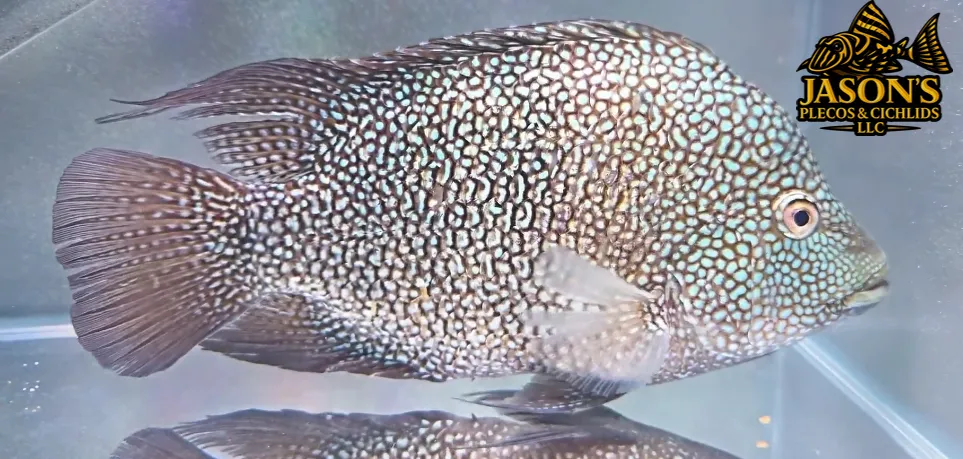
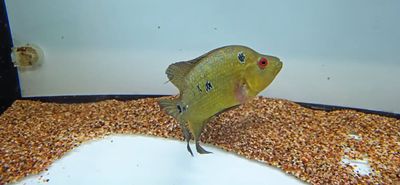
Green Texas Cichlid - (Herichthys carpintis)
$165.00
Captive Bred
was $190.00 Save 13%
Size
Required Reusable Shipping Bag
Questions, Comments, Concerns? Let us know!
Enter your text
Price of shipping is not included.
In stock: 1 available
1
Save this fish to my favorites.
Customer reviews
Reviews only from verified customers
No reviews yet. You can buy this product and be the first to leave a review.
Green Texas Cichlid - (Herichthys carpintis)
Fish Details, Description and Information Below:
🐟 Green Texas Cichlid – (Herichthys carpintis) – Brilliant Turquoise Pearlscale Cichlid
The Green Texas Cichlid (Herichthys carpintis), also known as the Pearlscale Cichlid, Lowland Cichlid, or Carpintis Cichlid, is a spectacular Mexican cichlid famous for its intense turquoise-blue and green pearling, bold personality, powerful body shape, and dramatic breeding coloration.
Mature specimens can become almost completely covered in brilliant metallic markings that may appear:
- Turquoise
- Electric blue
- Blue-green
- Emerald
- Aqua
against a darker gray, olive, or greenish background.
Although commonly sold under the name Green Texas Cichlid, Herichthys carpintis should not be confused with the true Texas Cichlid, Herichthys cyanoguttatus. They are two separate species.
The Green Texas Cichlid is an intelligent, territorial fish best suited for aquarists who enjoy large, interactive Central American-style cichlids and can provide adequate aquarium space, powerful filtration, secure décor, and carefully selected tankmates.
🔎 Quick Facts – Green Texas Cichlid
- 📛 Common Names: Green Texas Cichlid, Pearlscale Cichlid, Carpintis Cichlid, Lowland Cichlid
- 🔬 Scientific Name: Herichthys carpintis
- 🐟 Family: Cichlidae
- 🌎 Region: North America
- 🇲🇽 Native Country: Mexico
- 🌊 Native Range: Atlantic slope of eastern Mexico, including the Pánuco and Soto La Marina drainage region
- 💧 Water Type: Freshwater
- 📏 Scientific Maximum: Approximately 17 cm / 6.7 inches standard length
- 📏 Expected Aquarium Size: Approximately 8–10 inches total length for large adults
- 🏠 Recommended Aquarium: 75 gallons or larger for one adult
- 👥 Pair / Community: 90–125+ gallons strongly preferred
- 🌡️ Temperature: Approximately 73–82°F
- 💧 pH: Approximately 7.0–8.0
- 💦 Hardness: Approximately 9–20 dH
- 🍽️ Diet: Omnivore
- 😠 Temperament: Territorial / Semi-aggressive to aggressive
- 🐠 Swimming Area: Middle and lower portions
- 🥚 Breeding: Biparental substrate spawner
- ⭐ Care Level: Intermediate
- 🌎 Conservation Status: Least Concern
- 🏆 Availability: Popular specialty Mexican cichlid
💚 Why Is It Called a Green Texas Cichlid?
The name Green Texas Cichlid is an aquarium trade name.
The fish is scientifically:
Herichthys carpintis
It is not the true Texas Cichlid.
The name became popular because H. carpintis resembles the closely related:
Herichthys cyanoguttatus
which is the true Texas or Rio Grande Cichlid.
Both fish display beautiful metallic spotting, but they are distinct species.
🆚 Green Texas vs. True Texas Cichlid
This is one of the most important identification points for customers.
Green Texas / Pearlscale
Herichthys carpintis
Typically displays:
- Larger turquoise or blue-green spots
- Larger irregular pearl-like markings
- Heavier metallic coloration
- More projecting lower jaw
- Rounder lower body profile
- Mexican natural distribution
True Texas / Rio Grande Cichlid
Herichthys cyanoguttatus
Typically displays:
- Smaller individual iridescent spots
- Finer, more numerous spotting
- Different head and body proportions
- Natural distribution extending into Texas
Therefore:
Green Texas Cichlid does not mean the fish is naturally from Texas.
💎 Pearlscale Appearance
The name:
Pearlscale Cichlid
comes from the beautiful iridescent markings covering the fish.
These pearl-like markings can appear:
- Turquoise
- Electric blue
- Metallic green
- Aqua
- Blue-white
The spots may cover:
- Face
- Gill plates
- Body
- Dorsal fin
- Anal fin
- Tail
High-quality mature specimens can become almost completely covered in metallic pearling.
🎨 Color Development
Juvenile Green Texas Cichlids may not immediately display the spectacular coloration seen in adults.
Young specimens may initially appear:
- Gray
- Olive
- Brownish
- Light green
- Lightly spotted
As the fish matures, the metallic pearling can become:
- Larger
- Brighter
- More numerous
- More strongly contrasted
Color intensity is influenced by:
- Genetics
- Age
- Sex
- Dominance
- Diet
- Breeding condition
- Lighting
- Aquarium background
- Water quality
⚠️ Color Cannot Be Guaranteed
Every fish develops somewhat differently.
Even siblings may display differences in:
- Pearl size
- Pearl density
- Blue coloration
- Green coloration
- Body shape
- Adult markings
Good husbandry helps the fish express its genetic potential, but exact adult coloration cannot be guaranteed from a juvenile.
🌎 Native Range
Herichthys carpintis is native to:
Eastern Mexico
The species occurs on the Atlantic slope in lowland river systems associated with the:
- Río Pánuco
- Río Soto La Marina
- Nearby eastern Mexican drainages
It inhabits both:
- Flowing rivers
- Creeks
- Pools
- Lagoons
- Still or slow-moving waters
This adaptability helps make H. carpintis a relatively hardy aquarium cichlid when maintained under stable conditions.
📏 Adult Size
FishBase documents Herichthys carpintis at:
17 cm / approximately 6.7 inches standard length
Standard length does not include the tail fin.
For customer planning, approximately:
8–10 inches total adult length
is a reasonable expectation for a mature aquarium specimen.
Males usually become larger and heavier-bodied than females.
🏠 Aquarium Size
For one mature Green Texas Cichlid:
75 gallons or larger
is recommended.
For a compatible male/female pair:
90–125 gallons or larger
is strongly preferred.
For a mixed aquarium containing other large territorial cichlids:
125+ gallons
provides much more flexibility.
More space allows the fish to:
- Establish territory
- Escape aggression
- Swim naturally
- Create visual separation
- Avoid constant conflict
📐 Aquarium Footprint
Length and width are more important than excessive aquarium height.
A long aquarium provides:
- Greater swimming space
- More territory
- More hiding areas
- Better separation between fish
- More room for breeding pairs
This becomes particularly important as the fish matures.
🪨 Aquarium Setup
Recommended aquarium features include:
- Sand or smooth gravel
- Large rocks
- Driftwood
- Caves
- Visual barriers
- Open swimming areas
- Powerful filtration
- Good oxygenation
Create several distinct areas rather than one completely open aquarium when tankmates are present.
⚠️ Secure the Décor
Adult Green Texas Cichlids are strong fish.
They may:
- Dig
- Move gravel
- Rearrange rocks
- Move lightweight driftwood
- Uproot plants
- Claim caves
Large rocks should be positioned securely.
Never build unstable rock structures that could collapse if the fish excavates underneath them.
🌿 Plants
A planted aquarium is possible, but adult Carpintis may make it difficult.
They can:
- Dig around roots
- Uproot plants
- Damage softer plants
Hardy plants attached to:
- Rocks
- Driftwood
may have a better chance.
Possible choices include:
- Anubias
- Java fern
Even hardy plants are not guaranteed to remain untouched.
💧 Water Parameters
FishBase records natural conditions of approximately:
- 💧 pH: 7.0–8.0
- 💦 Hardness: 9–20 dH
- 🌡️ Temperature: 73–91°F / 23–33°C
For normal long-term aquarium care, I recommend:
- 🌡️ Temperature: 73–82°F
- 💧 pH: 7.0–8.0
- 💦 Hardness: 9–20 dH
- ☠️ Ammonia: 0 ppm
- ☠️ Nitrite: 0 ppm
- 🔄 Nitrate: Keep as low as reasonably possible
- 💨 Oxygenation: Good
This species generally does well in:
Neutral to moderately alkaline, mineral-rich water.
Stable conditions are more important than chasing one exact number.
💩 Filtration
Green Texas Cichlids:
- Eat heavily
- Dig
- Grow relatively large
- Produce substantial waste
Strong filtration is important.
Recommended filtration may include:
- Large canister filters
- Sump filtration
- Strong mechanical filtration
- High-capacity biological filtration
- Good surface agitation
Regular partial water changes should be part of normal maintenance.
🍽️ Diet & Feeding
The Green Texas Cichlid is an:
Omnivore
A varied diet should include both:
Animal + Plant-Based Nutrition
Recommended staple foods include:
- High-quality cichlid pellets
- Quality omnivore pellets
- Spirulina-containing pellets
- Vegetable-based cichlid foods
Supplemental foods may include:
- Mysis shrimp
- Krill
- Brine shrimp
- Shrimp
- Insect-based foods
- Appropriate frozen foods
Plant-based foods can include:
- Spirulina
- Peas
- Zucchini
- Other appropriate vegetable matter
🥬 Include Plant-Based Nutrition
Do not treat the Green Texas Cichlid as a strict carnivore.
A quality diet should contain:
- Plant matter
- Spirulina
- Appropriate fiber
- Animal protein
A varied omnivorous diet better reflects the feeding biology of the species.
🚫 Avoid Routine Feeder Fish
We do not recommend routinely feeding live feeder fish.
Feeder fish may introduce:
- Parasites
- Bacterial disease
- Viral disease
- Nutritional deficiencies
Green Texas Cichlids readily accept quality:
- Pellets
- Frozen foods
- Prepared foods
so routine feeder fish are unnecessary.
🚫 Avoid Overfeeding
Like many large cichlids, Carpintis quickly learn to recognize the person feeding them.
They may:
- Follow their keeper
- Approach the glass
- Beg constantly
- Respond aggressively at feeding time
Begging does not always mean hunger.
Chronic overfeeding can contribute to:
- Obesity
- Excessive waste
- Poor water quality
- Digestive problems
Feed controlled portions.
😠 Temperament
The Green Texas Cichlid is:
Territorial and Potentially Aggressive
Temperament varies by individual.
Some specimens coexist successfully with other robust fish.
Others become extremely dominant.
Aggression may increase as the fish:
- Matures
- Establishes territory
- Forms a pair
- Begins breeding
🚨 Breeding Aggression
A breeding pair can become:
Extremely Aggressive
toward anything entering their territory.
This may include:
- Other cichlids
- Catfish
- Plecos
- Other large fish
- Even the male or female partner
Always have a separation plan when keeping a pair.
🐠 Tankmates
Potential tankmates in a sufficiently large aquarium may include carefully selected:
- Other robust medium-to-large cichlids
- Large catfish
- Large plecos
- Large barbs
- Other sturdy fish with compatible water requirements
Avoid:
- Small community fish
- Tiny cichlids
- Delicate species
- Very timid fish
- Long-finned fish
Compatibility is never guaranteed.
⚠️ Best Tankmate Advice
A Green Texas Cichlid that peacefully lives with another fish as a juvenile may become incompatible with that same fish as an adult.
Always evaluate:
- Current size
- Adult size
- Territory
- Aquarium dimensions
- Individual temperament
and have an alternate housing plan.
♂️ Male vs. Female
Sexing juveniles can be difficult.
Mature Males
Males commonly:
- Grow larger
- Become heavier-bodied
- Develop longer dorsal and anal fins
- Develop broader heads
- May develop a nuchal hump
- Become more territorial
Mature Females
Females typically:
- Remain somewhat smaller
- Become fuller through the abdomen
- May display a dark dorsal-fin marking
- Develop dramatic breeding coloration
Venting mature fish is generally more reliable than judging only by fin shape or color.
⚫⚪ Dramatic Breeding Coloration
One of the most impressive characteristics of Herichthys carpintis is its breeding transformation.
When spawning, adults may change from their normal turquoise appearance into an extremely contrasting:
Black-and-White Breeding Dress
The lower portion of the body can become:
Deep black
while the upper body becomes:
Pale or whitish
The black coloration may extend forward along the underside toward the mouth.
This dramatic transformation is normal breeding coloration.
🥚 Breeding
The Green Texas Cichlid is a:
Biparental Substrate Spawner
A compatible pair selects and cleans a spawning site.
Possible sites include:
- Flat rocks
- Slate
- Large stones
- Flowerpots
- Cave walls
- Other solid surfaces
The female deposits eggs while the male fertilizes them.
🥚 Large Clutches
Healthy mature pairs may produce:
Several Hundred Eggs
The exact number varies according to:
- Female size
- Age
- Condition
- Pair compatibility
Eggs generally hatch after several days depending on temperature.
👨👩👧 Strong Parental Care
Both parents normally participate in caring for the brood.
They may:
- Fan eggs
- Remove damaged eggs
- Guard the spawning site
- Dig pits
- Move larvae
- Defend free-swimming fry
Few things demonstrate the personality of these fish better than watching a mature pair aggressively escort a cloud of fry around the aquarium.
👶 Raising Fry
Once free-swimming, fry can accept:
- Newly hatched baby brine shrimp
- Microworms
- Fine-quality fry foods
- Crushed flakes
- Finely crushed cichlid pellets
As they grow, introduce:
- Spirulina-containing foods
- Fine omnivore foods
- Larger pellets
Frequent small feedings combined with excellent water quality promote rapid growth.
💑 Pair Compatibility
Do not simply place a male and female together and assume they will form a compatible pair.
Large cichlids can seriously injure each other.
When pairing fish, provide:
- Large aquarium space
- Visual barriers
- Multiple hiding areas
- Escape routes
- Strong aquarium divider if necessary
Even an established pair may suddenly fight.
🧬 Preserve Pure Species Lines
Herichthys carpintis can hybridize with related cichlids.
If breeding for pure species stock, avoid mixing it with:
- Herichthys cyanoguttatus
- Other Herichthys
- Hybrid Texas-type cichlids
- Flowerhorn-type hybrids
If offspring are hybrids:
Always label them honestly as hybrids.
Maintaining accurate lineage is particularly important with H. carpintis because the trade already contains considerable confusion between Green Texas, True Texas, and hybrid forms.
⭐ Why Keep a Green Texas Cichlid?
The Green Texas Cichlid is one of the most beautiful Mexican cichlids available.
Its combination of:
- 💚 Metallic green coloration
- 💙 Brilliant turquoise pearling
- 💎 Large pearl-like spots
- 🧠 Intelligent personality
- 💪 Powerful adult body
- ⚫⚪ Dramatic breeding coloration
- 🥚 Strong parental care
- 🇲🇽 Mexican origin
- 🏆 Incredible centerpiece appearance
makes Herichthys carpintis an outstanding choice for cichlid enthusiasts.
A mature male displaying full turquoise pearling can be one of the most spectacular fish in a large freshwater aquarium.
⚠️ Important Considerations
Before purchasing a Green Texas Cichlid:
- Understand that it is Herichthys carpintis.
- Do not confuse it with the true Texas Cichlid, H. cyanoguttatus.
- Green Texas is a trade name; this species is naturally from Mexico.
- Plan for approximately 8–10 inches total adult length.
- Provide approximately 75 gallons or larger for one adult.
- Use 90–125+ gallons for pairs or tankmates.
- Maintain neutral to moderately alkaline water.
- Provide strong filtration.
- Feed a varied omnivorous diet.
- Include plant-based nutrition.
- Avoid routine feeder fish.
- Secure rocks and aquarium décor.
- Expect digging.
- Expect increasing territorial behavior with maturity.
- Expect significant aggression during breeding.
- Have a separation plan when keeping a pair.
- Preserve pure species lines when breeding.
- Never release aquarium fish into natural waterways.
🧬 Taxonomy
The currently accepted scientific name is:
Herichthys carpintis (Jordan & Snyder, 1899)
Older aquarium literature may contain names such as:
- Cichlasoma carpintis
- Neetroplus carpintis
- Cichlosoma laurae
For current product listings, use:
Herichthys carpintis
⚠️ Green Texas Name Disclaimer
“Green Texas Cichlid” is an aquarium trade name.
This species is:
Herichthys carpintis
and should not be confused with:
Herichthys cyanoguttatus
the true Texas / Rio Grande Cichlid.
The two are separate species and should be labeled accurately, especially when breeding.
🚚 Live Fish Shipping
Live fish are professionally packed for safe transport.
Shipping availability depends on:
- Fish size
- Destination
- Weather conditions
- Carrier availability
- Applicable state and local regulations
Larger specimens may require larger insulated shipping boxes or specialized packing.
Please review our Shipping & Payment Information and Live Arrival Guarantee / DOA Policy before ordering.
⚠️ Buyer Responsibility
Customers are responsible for confirming that Herichthys carpintis may legally be purchased, possessed, transported, and received in their state or local jurisdiction before ordering.
Never release aquarium fish into natural waterways.
Below are fish you may also like.
Captive Bred
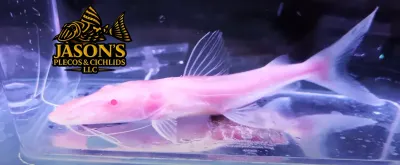
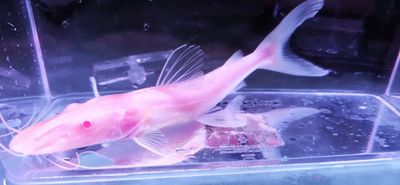
Albino Tiger Shovelnose Catfish - (Pseudoplatystoma fasciatum)
Albino Tiger Shovelnose Catfish - (Pseudoplatystoma fasciatum)
Price of shipping is not included.
was $4 000.00
Save 20%
$3 215.00
Wild Caught
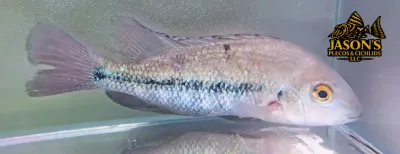
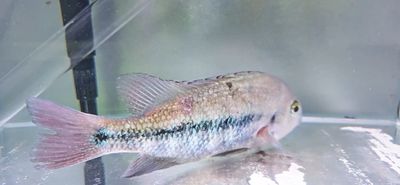
Papaloapan Cichlid - (Paraneetroplus Nebuliferum)
Papaloapan Cichlid - (Paraneetroplus Nebuliferum)
Price of shipping is not included.
was $250.00
Save 20%
$200.00
Captive Bred
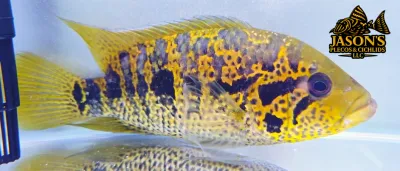
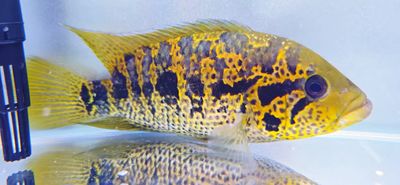
Yellowjacket Cichlid - (Parachromis multifasciatus)
Yellowjacket Cichlid - (Parachromis multifasciatus)
Price of shipping is not included.
5.0
(1)
was $85.00
Save 6%
$80.00
Captive Bred
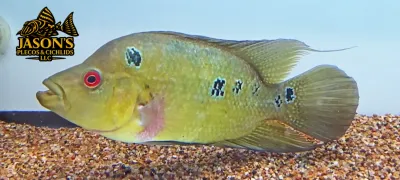
Trimac Cichlid/Three Spot Cichlid - (Amphilophus Trimaculatus)
Trimac Cichlid/Three Spot Cichlid - (Amphilophus Trimaculatus)
Price of shipping is not included.
was $190.00
Save 11%
$170.00
Wild Caught
L240 Black Saum Vampire Pleco - (Leporacanthicus cf. galaxias)
L240 Black Saum Vampire Pleco - (Leporacanthicus cf. galaxias)
Price of shipping is not included.
was $85.00
Save 6%
$80.00
Powered by Lightspeed
Display prices in:USD