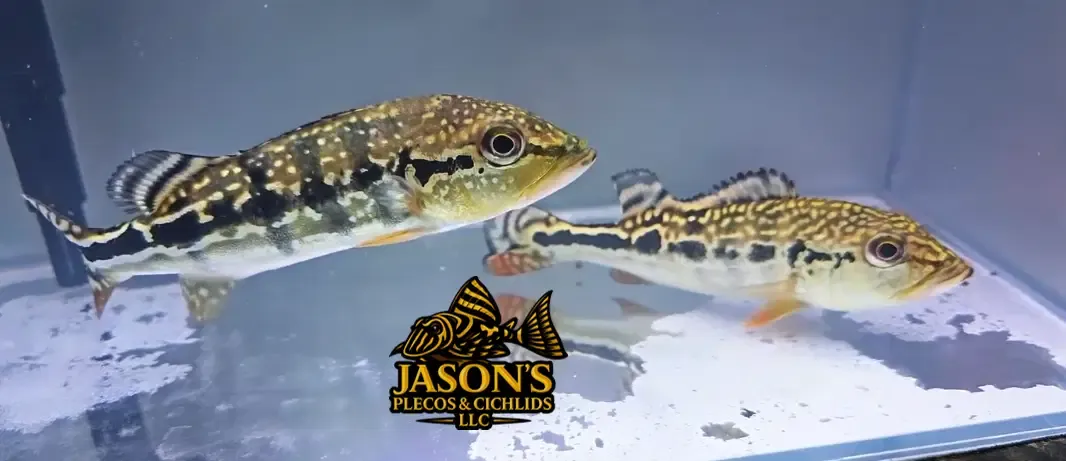
Cobra Snakeskin Peacock Bass - (Hybrid Peacock Bass)
5.0
1 review
Reviews from verified customers who have purchased products at this store.
$180.00
Sold out
was $190.00 Save 5%
Size
Questions, Comments, Concerns? Let us know!
Enter your text
Price of shipping is not included.
Sold out
Save this fish to my favorites.
Customer reviews
Reviews only from verified customers
Reviews are only accepted from verified customers who have signed in and purchased the products. This ensures that each review is based on genuine customer experiences. All reviews are checked before publication to prevent spam.
Jason P.
Evanston,
United States
Jan 8, 2026
Packaged extremely well, came in super healthy, always high quality from Jason
Cobra Snakeskin Peacock Bass - (Hybrid Peacock Bass)
Fish Details, Description and Information Below:
🐟 Cobra Snakeskin Peacock Bass – Captive-Bred Hybrid Peacock Bass
The Cobra Snakeskin Peacock Bass is a spectacular captive-bred hybrid Cichla developed for its extremely unusual maze-like, snakeskin pattern, metallic coloration, and exaggerated body markings.
Unlike naturally occurring Peacock Bass species that typically display more traditional vertical bars, spots, or ocelli, Cobra Snakeskins can develop intricate dark patterns running across a bronze, gold, olive, or greenish body. Mature fish may also display beautiful turquoise, emerald, gold, and metallic highlights depending on genetics, mood, lighting, and breeding line.
These fish originate from selective captive breeding rather than a naturally occurring wild population. Current aquarium-trade sources describe them as Asian-produced hybrid Peacock Bass, although the exact parental combination may vary between breeding lines.
The Cobra Snakeskin combines the dramatic appearance of a designer hybrid with the powerful feeding response, rapid growth, and predatory behavior expected from large Cichla.
For experienced monster-fish keepers with a sufficiently large aquarium, this is one of the most unusual Peacock Bass currently available in the aquarium hobby.
🔎 Quick Facts – Cobra Snakeskin Peacock Bass
- 📛 Common Name: Cobra Snakeskin Peacock Bass
- 🔬 Scientific Identification: Cichla sp. Hybrid
- 🧬 Type: Captive-Bred Hybrid Peacock Bass
- 🎨 Trade Form: Cobra / Snakeskin
- 🌏 Captive-Bred Origin: Asian ornamental fish breeding
- 🌎 Wild Ancestry: South American Cichla species
- 📏 Expected Adult Size: Approximately 18–24"+; potentially larger depending on parental lineage
- 🏠 Recommended Adult Aquarium: Approximately 300 gallons or larger
- 📐 Tank Shape: Long, wide aquarium with substantial open swimming space
- 🌡️ Temperature: Approximately 78–84°F
- 💧 pH: Approximately 6.0–7.5
- 💦 Water: Soft to moderately mineralized freshwater
- 🍽️ Diet: Carnivore / Piscivore
- 😠 Temperament: Predatory / Semi-aggressive to aggressive
- 🐠 Swimming Area: Middle / Open water
- ⭐ Care Level: Advanced
- 🏆 Availability: Rare specialty hybrid
🧬 What Is a Cobra Snakeskin Peacock Bass?
The Cobra Snakeskin is not a naturally occurring species.
It is a selectively bred hybrid involving members of the genus:
Cichla
The exact parental combination should not be assumed unless documented by the breeder.
Some aquarium sellers identify Snakeskin Peacock Bass as:
Cichla pinima × Cichla intermedia
while other sources describe Cobra Snakeskins as having been developed using multiple Cichla species.
Because hybrid breeding programs can involve multiple generations of selection and backcrossing, two fish sold under the same Cobra Snakeskin name may not necessarily have identical ancestry.
For Your Listing
I recommend identifying them simply as:
Captive-Bred Cichla sp. Hybrid
unless you have breeder documentation confirming the exact cross.
🐍 Why “Snakeskin”?
The name comes from the extremely intricate body pattern.
Instead of simple vertical bars, these fish may develop:
- Maze-like markings
- Wavy lines
- Broken horizontal markings
- Reticulated patterns
- Cobra-like markings
- Irregular spots
- Metallic scales
The overall appearance can resemble the pattern of a snake or reptile.
This characteristic becomes more dramatic as many individuals mature.
🎨 Appearance
Cobra Snakeskin Peacock Bass may display combinations of:
- Gold
- Bronze
- Olive
- Green
- Yellow
- Black
- Silver
- Turquoise
- Emerald-blue highlights
The head and upper body may develop dense spotting while the sides become covered in irregular dark lines and blotches.
The fins can also develop:
- Dark striping
- Spots
- Reticulated patterns
- Metallic edging
Like other designer hybrids, every individual can look different.
🎨 Pattern Disclaimer
Because these are selectively bred hybrid fish:
Exact adult coloration and pattern cannot be guaranteed.
A juvenile may change significantly as it grows.
Pattern development can be influenced by:
- Genetics
- Age
- Diet
- Dominance
- Stress
- Lighting
- Aquarium background
- Water quality
Some juveniles become significantly more patterned with maturity, while others may remain lighter or darker.
📏 Adult Size
This is one area where hybrid uncertainty matters.
Current sellers give substantially different estimates. One specialist describes the hybrid as being selected partly for a smaller adult size and lists approximately 18 inches, while other sellers advertise Cobra Snakeskins in the 20–30"+ range.
Because exact parentage can vary, I would tell customers:
Expect approximately 18–24"+ and plan for the possibility of a larger adult.
Do not guarantee that a Cobra Snakeskin will remain 18 inches simply because one breeding line reportedly does.
🚨 Do Not Purchase Based on Juvenile Size
Young Cobra Snakeskins may only be:
- 2 inches
- 3 inches
- 4 inches
- 5 inches
when offered for sale.
They are still large predatory cichlids.
Peacock Bass are fast-growing fish when:
- Fed heavily
- Maintained warm
- Given excellent water quality
Customers should have an adult aquarium plan before purchasing the juvenile.
🏠 Aquarium Size
Because the exact adult size of this hybrid can vary, I recommend being conservative.
For a mature Cobra Snakeskin Peacock Bass:
300 gallons or larger
is a sensible long-term recommendation.
For multiple Peacock Bass or additional monster fish:
400–500+ gallons may be required.
Aquarium dimensions are just as important as gallon volume.
📐 Aquarium Footprint
Peacock Bass are active open-water predators.
Prioritize:
- Length
- Width
- Open swimming space
rather than excessive aquarium height.
A long aquarium allows the fish to:
- Accelerate naturally
- Turn comfortably
- Establish territory
- Avoid tankmates
- Feed without constantly striking décor
For large adults, an aquarium approaching:
8 feet in length
is strongly preferred.
🏠 Aquarium Setup
Recommended aquarium features include:
- Large open swimming areas
- Sand or smooth substrate
- Large pieces of driftwood
- Smooth rocks
- Strong biological filtration
- Heavy mechanical filtration
- Powerful circulation
- High oxygenation
Keep most large decorations toward the:
- Rear
- Corners
- Sides
so the fish retains large open swimming lanes.
🚨 Easily Startled
Large Cichla can accelerate extremely quickly when frightened.
A startled Peacock Bass may slam into:
- Aquarium glass
- Driftwood
- Rocks
- Tank lids
This can cause:
- Snout damage
- Scale loss
- Eye injuries
- Jaw injuries
Avoid overcrowding the aquarium with hard décor.
A secure lid is also strongly recommended. One current seller specifically warns that Cobra Snakeskins are powerful and easily startled.
💩 Filtration
Large Peacock Bass:
- Eat heavily
- Grow rapidly
- Produce substantial waste
Strong filtration is essential.
Recommended filtration may include:
- Large sump systems
- Multiple high-capacity canister filters
- Heavy mechanical filtration
- Large biological filtration chambers
- Strong surface agitation
Maintain:
- ☠️ Ammonia: 0 ppm
- ☠️ Nitrite: 0 ppm
- 🔄 Nitrate: Keep as low as reasonably possible
- 💨 Oxygen: High
Frequent water changes are strongly recommended.
💧 Water Parameters
Because this is a hybrid rather than a wild species with one defined collection habitat, husbandry should focus on stable tropical Cichla-appropriate conditions.
Recommended aquarium range:
- 🌡️ Temperature: 78–84°F
- 💧 pH: 6.0–7.5
- 💦 Water: Soft to moderately mineralized
- 💨 Oxygenation: High
- ☠️ Ammonia: 0
- ☠️ Nitrite: 0
Current commercial care information for Cobra Snakeskins generally falls within approximately this range.
Stable water quality is more important than constantly adjusting pH.
🍽️ Diet & Feeding
The Cobra Snakeskin Peacock Bass is a:
Carnivorous Predator
Recommended foods include:
- High-quality carnivore pellets
- Large cichlid pellets
- Shrimp
- Prawns
- Krill
- Mysis shrimp
- Mussels
- Appropriate fish fillet
- Other high-quality frozen aquatic foods
Juveniles may initially prefer moving or frozen foods but can often be trained onto quality pellets.
🚫 Avoid Routine Feeder Fish
We do not recommend routinely feeding live feeder fish.
Feeder fish may introduce:
- Parasites
- Bacterial infections
- Viral infections
- Nutritional deficiencies
Peacock Bass can usually be trained to accept:
- Pellets
- Frozen foods
- Fresh seafood
A varied prepared diet provides much better control over nutrition.
🚫 Avoid Mammal & Poultry Meat
Do not routinely feed:
- Beef
- Beef heart
- Pork
- Chicken
These foods should not become staples for predatory aquarium fish.
Aquatic proteins and formulated carnivore foods are more appropriate.
😠 Temperament
Cobra Snakeskins are predatory fish.
Their primary danger to smaller tankmates is:
Being eaten.
Anything small enough to fit into the mouth should be considered potential prey.
They may also become territorial toward:
- Other Peacock Bass
- Similar-sized cichlids
- Competing predators
Individual temperament can vary.
🐠 Tankmates
Potential tankmates in a sufficiently large aquarium may include:
- Other similarly sized Peacock Bass
- Large Arowanas
- Large Datnoids
- Large Bichirs
- Large Catfish
- Large Plecos
- Other robust monster fish
Avoid:
- Small cichlids
- Small catfish
- Tetras
- Small plecos
- Small bichirs
- Community fish
- Any fish narrow enough to swallow
⚠️ Body Shape Matters
Do not judge whether a tankmate is safe only by its length.
A long but narrow fish may still fit inside a large Peacock Bass's mouth.
Consider:
- Body depth
- Width
- Head size
- Mouth size
when choosing tankmates.
👥 Keeping Multiple Peacock Bass
Peacock Bass are often maintained in groups when young.
A group can sometimes distribute aggression, but adults require enormous space.
As they mature:
- Dominance hierarchies can develop
- Pairing may occur
- Aggression may increase
- Weaker fish can become targets
Always have a plan for separating incompatible individuals.
♂️ Male vs. Female
Sexing juvenile Cobra Snakeskin Peacock Bass is extremely difficult.
Because this is a hybrid, there is also no established sexing guide specific to the Cobra Snakeskin form.
Adult males of some Cichla species may develop:
- Larger overall size
- More pronounced forehead development
- Changes in breeding coloration
But these traits should not be used to confidently sex juveniles.
Unless reliably determined:
Sell as Unsexed.
🥚 Breeding
Cobra Snakeskins are captive-produced hybrid Peacock Bass, proving that hybrid Cichla reproduction is possible under controlled breeding conditions.
However, breeding this particular designer form is not yet as standardized or well documented as breeding established Cichla species.
Parent species of the genus generally reproduce as:
Biparental substrate spawners
A compatible pair may clean a flat surface before laying eggs.
Both parents can become highly territorial while guarding:
- Eggs
- Larvae
- Fry
🧬 Breeding Hybrid Fish
If breeding Cobra Snakeskins, offspring should always be labeled honestly as:
Hybrid Peacock Bass
Do not sell offspring under the name of a pure wild Cichla species.
Hybrid ancestry can become increasingly difficult to determine after multiple generations of:
- Crossing
- Backcrossing
- Line breeding
Accurate records are especially valuable with designer Peacock Bass.
⭐ Why Keep a Cobra Snakeskin Peacock Bass?
The Cobra Snakeskin is an excellent choice for experienced monster-fish keepers looking for something much less common than a standard Peacock Bass.
Its combination of:
- 🐍 Unique snakeskin pattern
- 🎨 Metallic coloration
- 💚 Emerald and turquoise highlights
- 🧬 Designer hybrid genetics
- 🍽️ Powerful predatory feeding response
- 📏 Impressive adult size
- 🧠 Interactive behavior
- 🏆 Rare collector status
makes this one of the most distinctive captive-bred Cichla forms currently in the aquarium trade.
⚠️ Important Considerations
Before purchasing a Cobra Snakeskin Peacock Bass:
- Understand that this is a hybrid, not a naturally occurring species.
- Do not assume exact parentage unless breeder records are available.
- Expect approximately 18–24"+ adult size and plan for potentially larger specimens.
- Provide approximately 300 gallons or larger for long-term housing.
- Prioritize aquarium length and width.
- Maintain strong filtration.
- Maintain high oxygen levels.
- Keep ammonia and nitrite at zero.
- Provide open swimming space.
- Use a secure aquarium cover.
- Feed a varied carnivorous diet.
- Avoid routine feeder fish.
- Never house with fish small enough to swallow.
- Label offspring honestly if breeding.
- Never release hybrid aquarium fish into natural waterways.
This fish is recommended for experienced large-cichlid and monster-fish keepers.
🧬 Hybrid Identification Disclaimer
Cobra Snakeskin Peacock Bass is an aquarium trade designation.
Published aquarium-trade sources disagree on the exact ancestry. Some describe Snakeskins as Cichla pinima × Cichla intermedia, while others describe Cobra Snakeskin fish as a selectively bred combination involving multiple Cichla species.
Unless breeder documentation accompanies the fish, the most accurate identification is:
Cichla sp. Hybrid – Cobra Snakeskin
Pattern, coloration, adult size, and body shape may vary between individuals and breeding lines.
🚚 Live Fish Shipping
Live fish are professionally packed for safe transport.
Shipping availability depends on:
- Fish size
- Destination
- Weather
- Carrier availability
- Applicable state and local regulations
Larger specimens may require:
- Oversized insulated boxes
- Additional water
- Specialized packing
- Airline cargo shipping
Please review our Shipping & Payment Information and Live Arrival Guarantee / DOA Policy before ordering.
⚠️ Buyer Responsibility
Customers are responsible for confirming that hybrid Cichla may legally be purchased, possessed, transported, and received in their state or local jurisdiction before ordering.
Never release aquarium fish into local waterways.
Below are fish you may also like.
Captive Bred
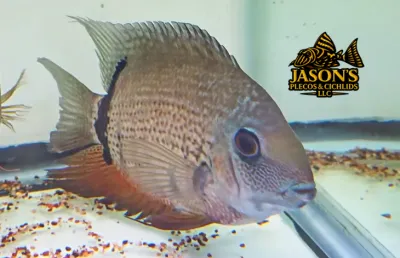
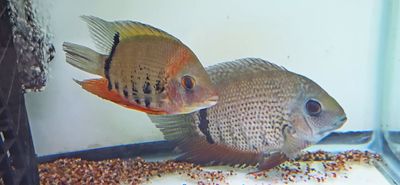
Green Severum - (Heros efasciatus)
Green Severum - (Heros efasciatus)
Price of shipping is not included.
5.0
(1)
was $75.00
Save 13%
$65.00
Captive Bred
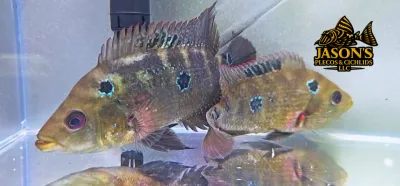
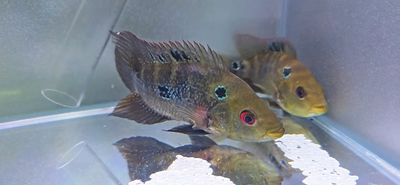
Trimac Cichlid/Three Spot Cichlid - (Amphilophus Trimaculatus)
Trimac Cichlid/Three Spot Cichlid - (Amphilophus Trimaculatus)
Price of shipping is not included.
5.0
(1)
was $70.00
Save 7%
$65.00
Wild Caught
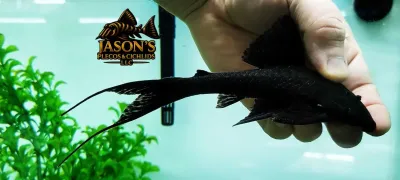
L350 Coal Pleco (Peckoltia pankimpuju)
L350 Coal Pleco (Peckoltia pankimpuju)
Price of shipping is not included.
5.0
(2)
was $325.00
Save 8%
$300.00
Wild Caught
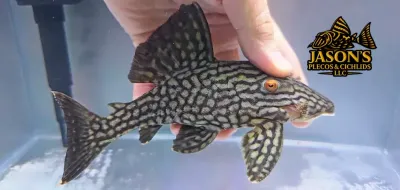
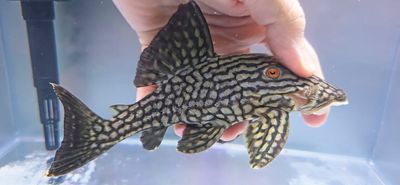
L330 Watermelon Pleco - (Panaque nigrolineatus laurafabianae)
L330 Watermelon Pleco - (Panaque nigrolineatus laurafabianae)
Price of shipping is not included.
was $250.00
Save 20%
$200.00
Wild Caught
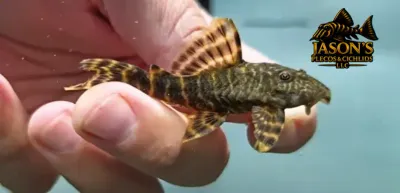
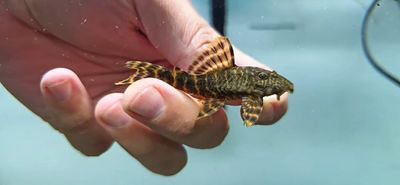
L104 Clown Pleco - (Panaqolus maccus)
L104 Clown Pleco - (Panaqolus maccus)
Price of shipping is not included.
5.0
(1)
was $45.00
Save 11%
$40.00
Powered by Lightspeed
Display prices in:USD