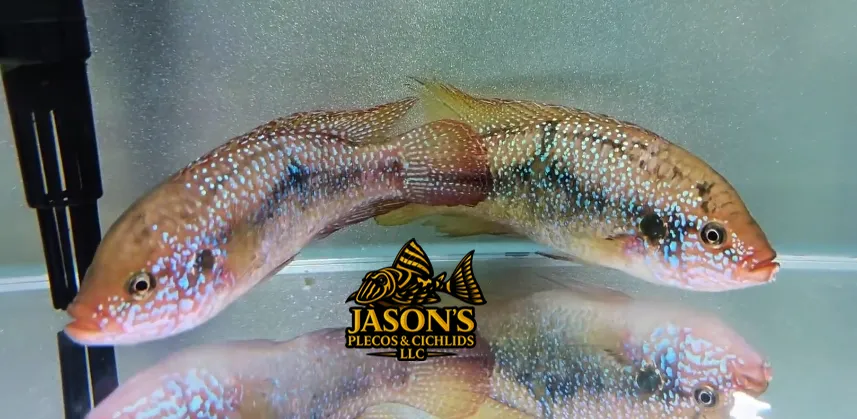
Turquoise Blue Jewel Cichlid - (Hemichromis Bimaculatus)
5.0
1 review
Reviews from verified customers who have purchased products at this store.
$20.00
Captive Bred
was $55.00 Save 64%
Size
Questions, Comments, Concerns? Let us know!
Enter your text
Price of shipping is not included.
In stock: 2 available
1
Save this fish to my favorites.
Customer reviews
Reviews only from verified customers
Reviews are only accepted from verified customers who have signed in and purchased the products. This ensures that each review is based on genuine customer experiences. All reviews are checked before publication to prevent spam.
NORTH ARLINGTON,
United States
Aug 28, 2026
Jason's is #1 in stock, shipping and customer service.
Turquoise Blue Jewel Cichlid - (Hemichromis Bimaculatus)
Fish Details, Description and Information Below:
💎 Turquoise Blue Jewel Cichlid – (Rubricatochromis bimaculatus) – Captive-Bred West African Jewel Cichlid
The Turquoise Blue Jewel Cichlid (Rubricatochromis bimaculatus), formerly known as Hemichromis bimaculatus, is a brilliantly colored African cichlid known for its intense turquoise-blue iridescence, metallic spotting, red to copper undertones, and dramatic breeding coloration.
The name:
TURQUOISE BLUE
is an aquarium trade and color-line description.
It is not a separate:
- Species
- Subspecies
- Scientific variety
- Formally recognized morph
Individual fish can vary considerably in the amount of:
- Turquoise blue
- Electric blue
- Green-blue
- Red
- Copper
- Bronze
that they display.
When mature and in good condition, the iridescent scales can create an almost jewel-like metallic covering over much of the body.
This listing is for:
CAPTIVE-BRED TURQUOISE BLUE JEWEL CICHLIDS
🔎 Quick Facts – Turquoise Blue Jewel Cichlid
- 📛 Common Name: Turquoise Blue Jewel Cichlid
- 📛 Other Names: Jewel Cichlid, African Jewel Cichlid, Jewelfish
- 🔬 Current Scientific Name: Rubricatochromis bimaculatus
- 📚 Older / Trade Scientific Name: Hemichromis bimaculatus
- 🐟 Family: Cichlidae
- 🧬 Subfamily: Pseudocrenilabrinae
- 🌿 Stock: Captive Bred
- 🎨 Color Name: Turquoise Blue – aquarium trade/color-line designation
- 🌎 Native Region of Species: Western Africa
- 🌍 Best-Supported Core Range: Guinea, Sierra Leone and Liberia
- 💧 Water Type: Freshwater; the species has also been recorded from some brackish environments
- 📏 Scientific Maximum: Approximately 13.6 cm / 5.4 inches standard length
- 📏 Adult Planning Size: Approximately 5–6 inches
- 🏠 Recommended Aquarium: 40 gallons or larger
- 💕 Adult Pair: 55+ gallons preferred
- 🐠 Community Setup: 75+ gallons strongly preferred, with compatibility never guaranteed
- 🌡️ Temperature: Approximately 75–82°F
- 💧 pH: Approximately 6.5–7.5
- 💦 Hardness: Approximately 4–16 dGH
- 💨 Oxygenation: Good
- 🌊 Water Movement: Low to Moderate
- 🍽️ Diet: Omnivore with strong animal/invertebrate component
- 🦐 Protein Foods: Important
- 🌿 Plant Matter: Supplemental
- 😠 Temperament: Territorial and aggressive
- 🚨 Breeding Temperament: Very Aggressive / Highly Territorial
- 🥚 Breeding: Open-Substrate Spawner
- 👨👩👧 Parental Care: Biparental
- 👶 Fry Care: Both parents guard eggs and fry
- ⭐ Care Level: Intermediate
- 🌎 IUCN Status: Least Concern
🧬 Important Scientific Name Update
For decades, this species was known as:
Hemichromis bimaculatus
That name remains extremely common throughout:
- Aquarium stores
- Older books
- Fish farms
- Hobby websites
- Wholesale lists
However, a major molecular and taxonomic revision of the jewel cichlid group was published in:
2022
The true jewel cichlid group was separated from Hemichromis and placed in the newly recognized genus:
Rubricatochromis
The currently accepted name is therefore:
Rubricatochromis bimaculatus
📚 Why You Will Still See Hemichromis bimaculatus
The older name:
Hemichromis bimaculatus
has been used in the aquarium hobby for generations.
For that reason, customers may continue to search for and recognize this fish under the old genus.
It is useful to mention both names, but the primary scientific name on an updated product page should be:
Rubricatochromis bimaculatus
with:
formerly Hemichromis bimaculatus
included for clarity.
💎 What Does Rubricatochromis Mean?
The genus name refers to the vivid:
RED COLORATION
displayed by many members of this jewel cichlid group, especially during:
- Dominance
- Courtship
- Spawning
- Parental care
These intense reds combined with metallic blue-green scales are responsible for the classic:
JEWEL CICHLID
appearance.
🎨 What Is a Turquoise Blue Jewel Cichlid?
“Turquoise Blue” describes the aquarium appearance of this captive-bred line.
Depending on the individual, coloration may include:
- Turquoise blue
- Electric blue
- Aqua blue
- Blue-green
- Metallic teal
- Copper
- Bronze
- Orange-red
- Crimson
The blue coloration is produced largely by:
IRIDESCENT REFLECTIVE SCALES
that can look dramatically different depending on lighting and viewing angle.
⚠️ Turquoise Blue Is Not a Separate Species
Do not list this fish as:
- Hemichromis sp. “Turquoise”
- Rubricatochromis turquoise
- A turquoise subspecies
- A naturally occurring scientific morph
unless future documentation establishes something different.
The appropriate identification is:
Turquoise Blue Jewel Cichlid – (Rubricatochromis bimaculatus)
⚠️ Color-Line Disclaimer
Exact adult coloration cannot be guaranteed.
Individual captive-bred fish may vary in:
- Amount of turquoise
- Blue intensity
- Red coloration
- Body darkness
- Spot density
- Fin coloration
Color can also change dramatically according to:
- Age
- Sex
- Dominance
- Breeding condition
- Stress
- Diet
- Aquarium lighting
- Background
- Water quality
💙 Iridescent Blue Scales
One of the most impressive characteristics is the extensive covering of:
METALLIC BLUE-GREEN SCALES
These can appear:
- Turquoise
- Sapphire blue
- Aqua
- Emerald-blue
- Neon blue
against a:
- Bronze
- Brown
- Red
- Copper
background.
❤️ Breeding Coloration
Jewel Cichlids can undergo dramatic color changes during reproduction.
A fish that normally looks:
- Bronze
- Brownish
- Blue-green
may become much more intensely:
- Red
- Crimson
- Turquoise
- Metallic blue
when:
PAIRING OR GUARDING FRY
⚫ Natural Dark Blotches
True Rubricatochromis bimaculatus is scientifically characterized by three dark blotch areas associated with the:
- Gill cover / operculum
- Middle of the body
- Base of the tail
The visibility of these markings can vary according to:
- Color strain
- Mood
- Stress
- Age
Highly colored captive-bred fish may not display them equally clearly at all times.
🌎 Native Distribution
The species is native to:
WESTERN AFRICA
Historically, the name Hemichromis bimaculatus was applied to Jewel Cichlids across an enormous portion of Africa.
Modern taxonomic work has shown that:
THE JEWEL CICHLID GROUP IS MUCH MORE COMPLEX THAN OLDER BOOKS SUGGESTED
⚠️ Older Range Information Can Be Misleading
Older sources attributed H. bimaculatus to areas ranging from:
- Western Africa
- Central Africa
- North Africa
- Nile drainage
Some of these records likely represent:
OTHER JEWEL CICHLID SPECIES
that were historically grouped under the same name.
🌍 Best-Supported Core Range
Current references particularly associate true:
Rubricatochromis bimaculatus
with western Africa, with some modern treatments restricting it primarily to:
- 🇬🇳 Guinea
- 🇸🇱 Sierra Leone
- 🇱🇷 Liberia
Therefore, I would describe the native region as:
WESTERN AFRICA
rather than repeating a very broad old distribution as absolute fact.
🌿 Natural Habitat
Wild Jewel Cichlids occur in habitats including:
- Small rivers
- Streams
- Canals
- Lagoons
- Forest-associated waters
- Mud-bottom habitats
- Sand-bottom habitats
- Vegetated margins
The species can tolerate a wider range of natural conditions than many highly specialized cichlids.
🪨 Aquarium Setup
A good Turquoise Blue Jewel Cichlid aquarium should contain:
- Rocks
- Caves
- Driftwood
- Flowerpot-style shelters
- Flat stones
- Sand or fine gravel
- Open swimming space
- Strong filtration
🪨 Provide Visual Barriers
Visual barriers are extremely useful because this species can become:
VERY TERRITORIAL
Use:
- Rocks
- Wood
- Caves
- Hardy plants
- Artificial décor
to break up direct lines of sight.
🌿 Plants
Plants may be used, but Jewel Cichlids can:
- Dig
- Move substrate
- Disturb roots
- Rearrange décor
especially when breeding.
Hardy plants attached to:
- Rocks
- Driftwood
are often easier to maintain than delicate rooted plants.
📏 Adult Size
FishBase currently documents a maximum of approximately:
13.6 CM STANDARD LENGTH
or:
5.4 INCHES BEFORE THE FULL TAIL FIN
For aquarium planning:
EXPECT APPROXIMATELY 5–6 INCHES
for a mature adult.
⚠️ Not a Tiny Cichlid
Although Jewel Cichlids are much smaller than many Central American cichlids, they should not be treated like:
- Rams
- Apistogramma
- Small shell dwellers
Their:
AGGRESSION CAN BE FAR GREATER THAN THEIR BODY SIZE SUGGESTS
🏠 Aquarium Size
For a single adult:
40 GALLONS OR LARGER
is a good starting point.
For an established pair:
55+ GALLONS IS PREFERRED
especially because breeding pairs can become highly territorial.
🐠 Community Aquarium Size
If attempting to maintain Jewel Cichlids with other robust fish:
75+ GALLONS
provides much more room for territories.
Even then:
COMPATIBILITY IS NEVER GUARANTEED
📐 Aquarium Length
Horizontal territory is much more valuable than excessive aquarium height.
A:
36–48 INCH OR LONGER AQUARIUM
is preferable for mature fish.
💧 Water Parameters
A practical captive range is:
- 🌡️ Temperature: Approximately 75–82°F
- 💧 pH: Approximately 6.5–7.5
- 💦 Hardness: Approximately 4–16 dGH
- 💨 Oxygenation: Good
- 🌊 Water Movement: Low to Moderate
- ☠️ Ammonia: 0 ppm
- ☠️ Nitrite: 0 ppm
🌡️ Temperature
Captive-bred Jewel Cichlids generally adapt well around:
75–82°F
They do not require the extreme temperatures used for:
- Discus
- Zebra Plecos
- Many warm-water Hypancistrus
⚠️ Stability Matters More Than Chasing an Exact Number
Avoid repeatedly adjusting:
- pH
- Hardness
- Temperature
to hit one exact value.
Stable, clean aquarium water is more important than constant chemical adjustment.
💩 Filtration
Use good:
- Mechanical filtration
- Biological filtration
- Water circulation
Suitable options include:
- Canister filters
- Hang-on-back filters
- Sponge filters
- Sumps
🔄 Water Changes
Regular partial water changes help maintain:
- Low nitrate
- Stable minerals
- Good coloration
- Strong appetite
- Breeding condition
🍽️ Diet – Omnivorous Predator
The Jewel Cichlid is best described as an:
OMNIVORE WITH A STRONG ANIMAL / INVERTEBRATE COMPONENT
Natural foods can include:
- Aquatic insects
- Insect larvae
- Small crustaceans
- Other invertebrates
- Small aquatic organisms
- Some plant material
🦐 High-Quality Protein Foods
Suitable aquarium foods include:
- Quality cichlid pellets
- Krill
- Mysis shrimp
- Brine shrimp
- Bloodworms
- Insect larvae
- Chopped shrimp
- Insect-based pellets
🌿 Plant Matter
Some vegetable or plant-containing foods can also be included.
Suitable options include:
- Spirulina-containing pellets
- Quality omnivore flakes
- Vegetable-containing cichlid foods
This helps create a balanced diet.
⚠️ Do Not Feed Only Meat
Even though Jewel Cichlids readily consume protein-rich foods, there is no need to maintain them exclusively on:
- Shrimp
- Bloodworms
- Krill
A varied, high-quality prepared cichlid diet is a better foundation.
🚫 Avoid Feeder Fish
Live feeder fish are unnecessary.
They can introduce:
- Parasites
- Bacteria
- Disease
- Poor nutritional balance
Use quality prepared and frozen foods instead.
😠 Temperament – Important
Jewel Cichlids are:
TERRITORIAL AND AGGRESSIVE
This is one of the most important things customers should understand before purchasing them.
🚨 Breeding Aggression Can Be Extreme
Once a compatible pair begins:
- Courtship
- Spawning
- Guarding eggs
- Raising fry
their aggression can increase dramatically.
A pair may attempt to claim:
MOST OR ALL OF THE AQUARIUM
🐠 Tankmates
Potential tankmates must be:
- Robust
- Appropriately sized
- Fast enough to avoid aggression
- Able to tolerate similar water conditions
Even compatible-looking combinations can fail when the Jewel Cichlids begin breeding.
🚫 Avoid Small Peaceful Fish
Do not combine adult Jewel Cichlids casually with:
- Neon-sized tetras
- Guppies
- Tiny rasboras
- Small peaceful cichlids
- Slow delicate fish
These may be:
- Chased
- Injured
- Killed
⚠️ Do Not Assume “African Cichlid” Means Malawi Tankmate
Jewel Cichlids are African cichlids, but they are:
NOT LAKE MALAWI MBUNA
and do not automatically belong in a typical:
- Malawi
- Tanganyika
- Rift Lake
community.
Their natural ecology and water requirements are different.
👥 Keeping More Than One
The safest way to establish a breeding pair is often to:
- Start with several juveniles.
- Allow a compatible pair to form naturally.
- Remove unpaired or targeted fish as aggression increases.
Simply placing:
ONE RANDOM MALE + ONE RANDOM FEMALE
together does not guarantee compatibility.
⚠️ Pair Bond Does Not Eliminate Aggression
Even established pairs may fight.
Watch for:
- Torn fins
- Cornering
- Constant chasing
- Refusal to eat
- One fish hiding continuously
Be prepared to:
SEPARATE THE PAIR
if necessary.
♂️ Male vs. Female
Sexing Jewel Cichlids visually can be difficult.
Both sexes can develop:
- Brilliant coloration
- Turquoise spotting
- Red breeding colors
♂️ Mature Males
Males may:
- Grow somewhat larger
- Develop slightly more extended dorsal or anal fins
- Show stronger territorial behavior
♀️ Mature Females
Females can become:
EXTREMELY BRIGHTLY COLORED
when ready to spawn.
Do not assume the brightest fish is automatically male.
⚠️ Sell Juveniles as Unsexed
Young captive-bred Jewel Cichlids can be difficult to sex accurately.
Unless sex has been confidently determined:
SELL AS UNSEXED
🥚 Breeding – Substrate Spawner
The Turquoise Blue Jewel Cichlid is an:
OPEN-SUBSTRATE SPAWNER
A compatible pair generally selects a:
- Flat rock
- Broad stone
- Flowerpot
- Flat piece of décor
- Aquarium surface
and cleans it before spawning.
🚫 Not a True Mouthbrooder
Jewel Cichlids should not be described as:
MOUTHBROODING CICHLIDS
They are primarily:
SUBSTRATE SPAWNERS
Parents may occasionally use their mouths to:
- Move larvae
- Relocate fry
- Transfer offspring into prepared pits
but that is different from incubating the entire brood inside the mouth.
💕 Courtship
When ready to reproduce, the pair may:
- Intensify coloration
- Clean a spawning surface
- Display toward one another
- Dig pits
- Defend a territory aggressively
🥚 Egg Laying
The female lays adhesive eggs across the chosen spawning surface.
The male follows and fertilizes them.
Large mature females can produce:
HUNDREDS OF EGGS
with some breeding accounts reporting clutches approaching:
600 EGGS
Large clutches should not be guaranteed.
👨👩👧 Biparental Care
Both parents participate in brood care.
They may:
- Fan the eggs
- Remove damaged eggs
- Defend the nest
- Attack intruders
- Dig nursery pits
- Move newly hatched larvae
- Guard free-swimming fry
🐣 Hatching
At warm aquarium temperatures, eggs may hatch after roughly:
2–3 DAYS
depending on:
- Temperature
- Water quality
- Oxygenation
🕳️ Nursery Pits
The parents may dig shallow pits in the substrate and move newly hatched larvae into them.
The brood may be relocated more than once before becoming free-swimming.
👶 Free-Swimming Fry
Once free swimming, suitable foods include:
- Baby brine shrimp
- Fine fry food
- Crushed flakes
- Microworms
- Small powdered foods
👨👩👧 Excellent Parents
One of the most fascinating behaviors of Jewel Cichlids is their:
STRONG PARENTAL CARE
Both adults can aggressively protect their offspring for several weeks.
🚨 This Is When Aggression Peaks
A breeding pair with fry may become dangerous to virtually every other fish in the aquarium.
Be prepared to:
- Remove tankmates
- Use a divider
- Move the pair
- Maintain a species-only breeding aquarium
🧬 Preserve Species & Color-Line Records
The Jewel Cichlid group has a long history of:
- Misidentification
- Outdated scientific names
- Similar-looking species
- Captive-bred color lines
If breeding these fish for resale:
- Preserve supplier identification
- Preserve the Turquoise Blue line name
- Maintain parent records
- Do not mix unrelated jewel species and later market offspring as pure R. bimaculatus
⚠️ Aquarium Jewel Cichlid Identification Can Be Complicated
The old genus Hemichromis historically contained numerous similar red jewel cichlids.
Modern research has shown that several are separate species.
Captive aquarium lines may also have been maintained for many generations.
Therefore:
DO NOT MAKE A WILD LOCALITY CLAIM FOR A CAPTIVE-BRED COLOR LINE WITHOUT DOCUMENTATION
The species-level origin can correctly be described as Western Africa while the captive line itself should simply be identified as:
CAPTIVE BRED
unless breeder records establish more.
🌎 Conservation Status
The wild species:
Rubricatochromis bimaculatus
is currently assessed as:
LEAST CONCERN
The global assessment dates to:
2020
⚠️ Turquoise Blue Has No Separate Conservation Status
The Turquoise Blue aquarium line is not a separate wild taxon.
Therefore, it does not have its own:
- IUCN category
- CITES listing
- Conservation assessment
🌎 Invasive-Species Responsibility
Jewel Cichlids and related African cichlids have been introduced outside their natural range through the aquarium trade.
Historical U.S. records involving “H. bimaculatus” are complicated because some introduced Jewel Cichlids were later determined to have been misidentified as other related species.
Regardless of exact species:
NEVER RELEASE JEWEL CICHLIDS INTO THE WILD
🚨 Never Release Aquarium Fish
Never release unwanted Jewel Cichlids into:
- Rivers
- Streams
- Lakes
- Ponds
- Canals
- Springs
- Storm drains
Instead:
- Rehome the fish
- Contact an aquarium store
- Contact another experienced keeper
- Contact an aquatic rescue when available
⭐ Why Keep a Turquoise Blue Jewel Cichlid?
The Turquoise Blue Jewel combines:
- 💎 Brilliant jewel-like coloration
- 💙 Intense turquoise iridescence
- ❤️ Dramatic red breeding colors
- 🌍 West African cichlid heritage
- 📏 Manageable approximately 5–6 inch adult size
- 🍽️ Easy-to-feed omnivorous diet
- 🧠 Intelligent cichlid behavior
- 💕 Strong pair bonding
- 🥚 Readily achievable captive breeding
- 👨👩👧 Exceptional biparental care
into an extremely colorful fish for aquarists prepared for its aggressive personality.
⚠️ Important Considerations
Before purchasing a Turquoise Blue Jewel Cichlid:
- The currently accepted scientific name is Rubricatochromis bimaculatus.
- Hemichromis bimaculatus is the older scientific combination.
- The genus change resulted from the modern revision of the Jewel Cichlid group.
- “Turquoise Blue” is an aquarium trade/color-line designation.
- It is not a separate species or subspecies.
- This listing is for captive-bred fish.
- Do not make wild locality claims for the captive line unless documented.
- The species originates from Western Africa.
- Modern references particularly associate true R. bimaculatus with Guinea, Sierra Leone and Liberia.
- Older reports attributed the name to a much broader African range.
- Historic Jewel Cichlid identification can be complicated.
- Adult size is approximately 5–6 inches.
- FishBase documents up to approximately 13.6 cm standard length.
- Provide approximately 40 gallons or larger for one adult.
- 55+ gallons is preferred for an established pair.
- Use substantially larger aquariums if attempting tankmates.
- Maintain approximately 75–82°F.
- Maintain approximately pH 6.5–7.5.
- Provide good filtration and stable water quality.
- Feed a varied omnivorous diet.
- Animal and insect foods are important.
- Quality cichlid pellets make an excellent staple.
- Avoid feeder fish.
- Expect territorial and aggressive behavior.
- Breeding aggression can become extreme.
- Do not combine casually with small or delicate community fish.
- Do not assume this fish belongs in a typical Malawi or Tanganyika aquarium simply because it is African.
- Jewel Cichlids are substrate spawners.
- They are not true mouthbrooders.
- Both parents guard eggs and fry.
- Large females can produce hundreds of eggs.
- Keep breeding records if maintaining the Turquoise Blue line.
- Avoid mixing different Jewel Cichlid species if offspring will be represented as pure.
- The wild species is currently Least Concern.
- Never release aquarium fish into natural waterways.
🧬 Taxonomy
The currently accepted scientific name is:
Rubricatochromis bimaculatus (Gill, 1862)
Classification:
- Order: Cichliformes
- Family: Cichlidae
- Subfamily: Pseudocrenilabrinae
- Genus: Rubricatochromis
- Species: bimaculatus
Older scientific name:
Hemichromis bimaculatus
The genus:
Rubricatochromis
was established during the modern taxonomic revision of the Jewel Cichlid group.
For this product, use:
Turquoise Blue Jewel Cichlid – (Rubricatochromis bimaculatus)
and include:
Formerly Hemichromis bimaculatus
within the product description for customers familiar with the older name.
🎨 Turquoise Blue Line Disclaimer
“Turquoise Blue” is a captive aquarium trade/color-line designation.
Individual fish may vary significantly in:
- Turquoise coverage
- Blue intensity
- Red coloration
- Spotting
- Body darkness
Exact adult color cannot be guaranteed.
Unless breeder documentation specifically establishes a wild locality or documented strain history, the fish should simply be represented as:
CAPTIVE-BRED TURQUOISE BLUE JEWEL CICHLID
rather than as a wild locality form.
🚚 Live Fish Shipping
Live fish are professionally packed for safe transport.
Shipping availability depends on:
- Fish size
- Destination
- Weather conditions
- Carrier availability
- Applicable state and local regulations
Please review our Shipping & Payment Information and Live Arrival Guarantee / DOA Policy before ordering.
⚠️ Buyer Responsibility
Customers are responsible for confirming that Rubricatochromis bimaculatus may legally be purchased, possessed, transported, and received in their state or local jurisdiction before ordering.
Never release aquarium fish into natural waterways.
Powered by Lightspeed
Display prices in:USD