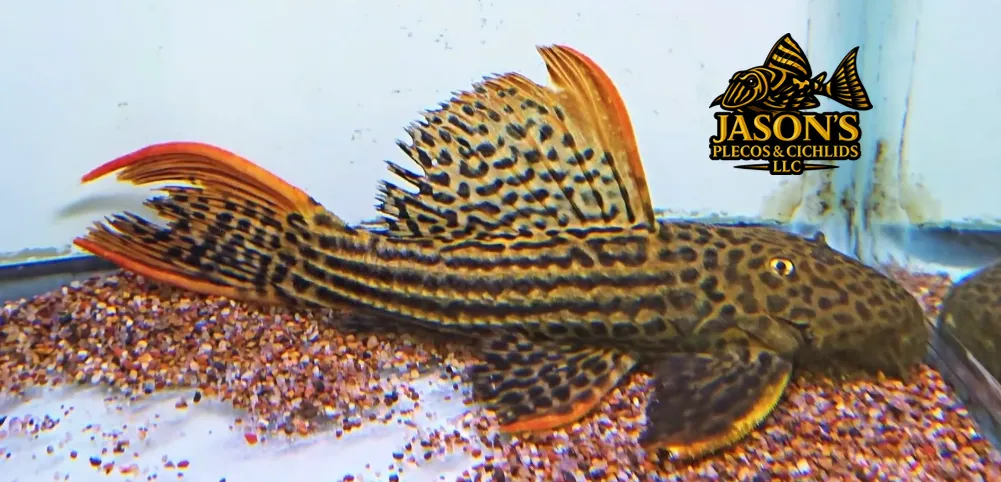
L025 Scarlet Cactus Pleco 7 Pointer - (Pseudacanthicus pirarara)
$515.00
Wild Caught
was $550.00 Save 6%
Size
Questions, Comments, Concerns? Let us know!
Enter your text
Special Reusable Shipping Bag
3 Digit Airport Code
Price of shipping is not included.
In stock: 2 available
1
Save this fish to my favorites.
Customer reviews
Reviews only from verified customers
No reviews yet. You can buy this product and be the first to leave a review.
L025 Scarlet Cactus Pleco 7 Pointer - (Pseudacanthicus pirarara)
Fish Details, Description and Information Below:
🔥 L025 Scarlet Cactus Pleco 7 Pointer – (Pseudacanthicus pirarara) – Wild-Caught Rio Xingu Cactus Pleco
The L025 Scarlet Cactus Pleco 7 Pointer (Pseudacanthicus pirarara) is one of the most spectacular large plecos from Brazil's famous Rio Xingu Basin.
Known for its heavily armored body, pronounced rows of odontodes, dramatic dark markings, powerful build, and intense scarlet-red to orange-red fin coloration, the L025 develops into an incredible showpiece fish for a properly equipped large aquarium.
The 7 Pointer form is especially prized for displaying strong red or orange coloration on the tips or leading edges of all seven individual fins:
- 🔥 Dorsal fin
- 🔥 Caudal fin
- 🔥 Anal fin
- 🔥 Left pectoral fin
- 🔥 Right pectoral fin
- 🔥 Left pelvic fin
- 🔥 Right pelvic fin
This intense seven-fin coloration is the origin of the aquarium-trade term:
7 POINTER
The name describes a particularly colorful form of Pseudacanthicus pirarara and is not a separate species or subspecies.
L025 is a large, powerful, strongly territorial pleco that can reach approximately 15–17 inches, with exceptional specimens potentially becoming even larger.
Unlike many plecos commonly associated with algae grazing, the Scarlet Cactus Pleco is a strongly carnivorous, protein-oriented omnivore that should receive a diet built around aquatic animal foods and high-quality sinking carnivore diets.
This listing is for:
WILD-CAUGHT L025 SCARLET CACTUS PLECO 7 POINTERS
🔎 Quick Facts – L025 Scarlet Cactus Pleco 7 Pointer
- 📛 Common Name: Scarlet Cactus Pleco
- 📛 Other Names: Scarlet Pleco, Redfin Cactus Pleco, Red Devil Pleco
- 🔥 Trade Form: 7 Pointer
- 🔢 L-Number: L025
- 🔬 Scientific Name: Pseudacanthicus pirarara
- 🐟 Family: Loricariidae
- 🧬 Subfamily: Hypostominae
- 🐣 Stock: Wild Caught
- 🇧🇷 Country: Brazil
- 🌊 Native Range: Rio Xingu Basin
- 📍 Species Distribution: Lower and Middle Rio Xingu and tributaries including the Rio Iriri and Rio Bacajá
- 📍 7 Pointer Association: Particularly associated in the aquarium trade with upper Xingu / São Félix do Xingu forms
- 💧 Water Type: Freshwater
- 📏 FishBase Maximum: Approximately 40.5 cm / 15.9 inches total length
- 📏 Adult Planning Size: Approximately 15–17 inches
- 📏 Exceptional Adults: 16"+ individuals are well documented, with some specialist references approaching 18 inches
- 🏠 Recommended Aquarium: 125 gallons minimum for one adult
- 🏠 Preferred Aquarium: 180+ gallons for a mature adult
- 👥 Multiple Large Plecos: Significantly larger aquarium required
- 🌡️ Temperature: Approximately 78–86°F
- 💧 pH: Approximately 6.0–7.5
- 💨 Oxygenation: Very High
- 🌊 Water Movement: Moderate to Strong
- 🍽️ Diet: Carnivorous / Protein-Leaning Omnivore
- 😠 Temperament: Highly territorial toward other plecos
- 🌙 Activity: Primarily nocturnal / crepuscular
- 🐠 Swimming Area: Bottom
- 🥚 Breeding: Cave Spawner
- ⭐ Care Level: Advanced
- 🌎 IUCN Status: Not Evaluated
- 🏆 Type: Large Rio Xingu Showpiece Pleco
🧬 A Formally Described Species
L025 was known in the aquarium hobby for many years before receiving its formal scientific name.
In 2016, it was formally described as:
Pseudacanthicus pirarara
The currently accepted species name remains:
Pseudacanthicus pirarara Chamon & Sousa, 2016
It should therefore no longer be identified simply as:
Pseudacanthicus sp. L025
although the L025 designation remains extremely important in the aquarium hobby.
🔥 What Does “7 Pointer” Mean?
The term:
7 Pointer
is an aquarium-trade description for exceptionally colorful L025 specimens displaying strong red or orange coloration on all seven individual fins.
A fish has:
- One dorsal fin
- One caudal fin
- One anal fin
- Two pectoral fins
- Two pelvic fins
That equals:
7 Individual Fins
The red coloration may appear primarily on:
- Leading fin rays
- Outer fin edges
- Fin tips
and can vary in intensity between individuals.
⚠️ 7 Pointer Does NOT Mean Seven Dorsal Spines
An older version of this listing described 7 Pointer as:
“Seven prominent white or yellow spines on the dorsal fin.”
That is incorrect.
The term refers to:
RED / ORANGE COLORATION ACROSS ALL SEVEN FINS
not seven dorsal-fin spines.
🗺️ 7 Pointer Locality
In the aquarium trade, particularly colorful 7 Pointer L025s are strongly associated with:
The Rio Xingu Around São Félix do Xingu
Other L025 populations occur throughout portions of the:
- Rio Xingu
- Rio Iriri
- Rio Bacajá
Color intensity and pattern can vary according to collection locality.
However:
Exact locality should only be advertised when supplier or collection records support it.
If exact locality is unknown, identify the fish simply as:
Rio Xingu Basin – Brazil
🔥 Why Is It Called the Scarlet Cactus Pleco?
The common name combines two of the fish's most obvious characteristics.
Scarlet
refers to the intense:
- Red
- Scarlet
- Orange-red
coloration along the fins.
Cactus
refers to the extraordinary number of:
Odontodes
covering portions of the body and fins.
These tooth-like projections give the fish an armored, spiny appearance similar to a cactus.
🌵 What Are Odontodes?
Odontodes are small tooth-like structures growing externally from the fish's armored surfaces.
L025 can develop especially impressive odontodes on the:
- Cheeks
- Pectoral fins
- Body
- Fin rays
Mature males may become particularly heavily armed.
These structures are used in:
- Territory defense
- Competition
- Breeding interactions
They can also make handling difficult.
⚠️ Powerful Spines & Odontodes
A large Scarlet Cactus Pleco should never be casually grabbed.
The fish's combination of:
- Heavy armor
- Strong pectoral spines
- Odontodes
- Powerful body
can cause injury.
Large specimens may also become badly tangled in conventional fish nets.
When moving a large L025, experienced keepers often use:
- Large rigid containers
- Fish tubs
- Heavy-duty transfer containers
rather than conventional netting.
🎨 Appearance
Typical body coloration may include:
- Dark gray
- Olive
- Brown
- Charcoal
- Nearly black
with dark blotches and markings forming:
- Zigzag patterns
- Irregular bands
- Connected blotches
- Longitudinal markings
The fins contrast dramatically with:
- Scarlet
- Orange
- Orange-red
- Deep red
coloration.
🧬 Scientific Identification
One feature used to distinguish Pseudacanthicus pirarara from related species is its combination of:
- Connected dark blotches forming zigzag bands along the body
- Dark markings on the underside
- Strong orange-to-red coloration on the unbranched fin rays
- Red coloration that may extend onto neighboring branched rays
These characteristics help separate it from similar species such as:
- Pseudacanthicus pitanga
- Pseudacanthicus leopardus
🆚 L025 vs. L024
L025 is commonly confused with:
L024 – Pseudacanthicus pitanga
Both are large red-finned cactus plecos.
However:
L025 – Pseudacanthicus pirarara
- Rio Xingu Basin
- Generally darker body
- More extensive intense red coloration
- Scarlet coloration can occur on all fins
- Different body markings
L024 – Pseudacanthicus pitanga
- Tocantins-Araguaia Basin
- Different pattern and locality
- Generally less extensive scarlet coloration
They are:
Separate Species
and should not be mixed or mislabeled.
📏 Adult Size
FishBase currently records:
40.5 cm / approximately 15.9 inches total length
for Pseudacanthicus pirarara.
Specialist loricariid references also document:
16"+ Adults
and some references report maximum potential approaching:
17–18 inches
For customer planning, I recommend:
Approximately 15–17 Inches
with the understanding that exceptionally large individuals may exceed that range.
🚨 Do Not Purchase Based on Current Size
A juvenile or subadult L025 may appear manageable.
A mature specimen becomes:
- Large
- Thick-bodied
- Extremely powerful
- Heavily armored
- Territorial
- Heavy feeding
- Heavy waste producing
Customers should purchase this fish based on its:
ADULT SIZE
not its current sale size.
🏠 Aquarium Size
For one mature L025 Scarlet Cactus Pleco:
125 gallons should be considered the minimum
with:
180 gallons or larger strongly preferred
for a fully grown adult.
Larger aquariums are particularly important when keeping:
- Large cichlids
- Other plecos
- Additional bottom dwellers
- Multiple L025s
📐 Aquarium Footprint Matters
This species spends most of its life near the bottom.
Prioritize:
Length + Width
rather than excessive aquarium height.
A mature Scarlet Cactus Pleco requires enough floor space to:
- Turn comfortably
- Establish territory
- Enter large caves
- Feed without competition
- Avoid tankmates
A wide aquarium becomes increasingly important as the fish reaches 15"+.
🏠 Aquarium Setup
An ideal L025 aquarium should contain:
- Large caves
- Large rock structures
- Slate
- Smooth boulders
- Driftwood
- Sand or smooth gravel
- Open bottom areas
- Strong filtration
- Strong circulation
- Excellent oxygenation
- Secure aquarium cover
Décor must be extremely stable.
⚠️ Secure Heavy Décor
Large Pseudacanthicus are powerful fish.
They can:
- Push rocks
- Move wood
- Dig around structure
- Rearrange caves
Do not create unstable rock piles.
Place major rock structures securely so the fish cannot undermine them.
🏠 Large Caves Are Essential
A mature L025 needs an appropriately sized shelter.
Suitable options include:
- Extra-large ceramic pleco caves
- Large PVC-style breeding tubes
- Slate caves
- Rock crevices
- Large protected cavities
The fish should be able to:
- Enter completely
- Turn or position comfortably
- Defend the shelter
When multiple large plecos are present:
Provide More Shelters Than Fish
🌊 Natural Habitat
Pseudacanthicus pirarara is endemic to:
Brazil's Rio Xingu Basin
and occurs in portions of the:
- Lower Rio Xingu
- Middle Rio Xingu
- Rio Iriri
- Rio Bacajá
These are clear-water environments containing:
- Large rocks
- Boulders
- Rapids
- Strong currents
- Highly oxygenated water
The species is strongly associated with rocky bottom habitat.
💨 HIGH OXYGENATION IS ESSENTIAL
The Rio Xingu is warm.
Warm water holds less oxygen than cooler water.
At the same time, a large L025:
- Has substantial body mass
- Eats heavily
- Produces significant waste
- Is adapted to moving water
Therefore:
EXTREMELY GOOD OXYGENATION IS IMPORTANT
Use:
- Strong surface agitation
- Powerful filter returns
- Air stones
- Powerheads
- Circulation pumps
- Sump filtration
as necessary.
🌊 Water Movement
Provide:
Moderate to Strong Current
while also creating sheltered areas behind:
- Rocks
- Wood
- Caves
where the fish can rest.
The aquarium does not need to be a torrent everywhere.
An ideal design offers:
Strong Flow Areas + Protected Resting Areas
💧 Water Parameters
A practical captive range is approximately:
- 🌡️ Temperature: 78–86°F
- 💧 pH: 6.0–7.5
- 💦 Water: Soft to moderately mineralized
- 💨 Oxygenation: Very High
- 🌊 Flow: Moderate to Strong
- ☠️ Ammonia: 0 ppm
- ☠️ Nitrite: 0 ppm
- 🔄 Nitrate: Keep as low as reasonably practical
Some specialist references maintain L025 somewhat cooler, while others use approximately 79–86°F.
For long-term care:
Stability + Excellent Oxygenation
matter more than forcing one exact temperature.
💩 Massive Filtration Requirements
A 15–17 inch carnivorous pleco creates substantial waste.
Strong filtration is mandatory.
Recommended filtration may include:
- Large sump filtration
- Large canister filtration
- Oversized biological filtration
- Heavy mechanical filtration
- Filter socks or rollers
- Powerful circulation
Regular large water changes should be expected.
🍽️ Diet – Strongly Protein Oriented
The Scarlet Cactus Pleco is best considered a:
Carnivorous / Protein-Leaning Omnivore
It is very different nutritionally from large algae-grazing plecos.
Recommended foods include:
- 🦐 Shrimp
- 🦪 Mussels
- 🦪 Cockles
- Krill
- Mysis shrimp
- Bloodworms
- Earthworms
- Insect-based foods
- Quality sinking carnivore pellets
- High-quality large catfish pellets
🦐 Aquatic Protein Should Form the Core Diet
Large L025s particularly appreciate:
- Prawn
- Mussel
- Shrimp
- Other appropriate aquatic invertebrates
These foods closely match the protein-oriented feeding behavior associated with the genus.
🌿 Should L025 Eat Vegetables?
Small amounts of plant-based foods can still be offered for dietary variety.
Possible foods include:
- Zucchini
- Peas
- Spirulina-containing foods
- Vegetable-containing sinking pellets
However:
Vegetables should not form the primary diet.
Do not maintain L025 like an herbivorous pleco.
🚫 Not an Algae-Eating Pleco
Do not purchase an L025 expecting it to clean algae.
It is:
NOT AN ALGAE-CLEANING SPECIES
While it may occasionally graze surfaces or consume miscellaneous food, aquarium algae does not meet its nutritional requirements.
Feed the fish intentionally.
🪵 Driftwood
Driftwood is useful for:
- Shelter
- Shade
- Territory boundaries
- Natural structure
However:
L025 is not a specialized wood eater.
It does not require wood as a digestive food source.
Use driftwood for:
- Habitat
- Cover
- Enrichment
rather than as nutrition.
🚫 Avoid Routine Feeder Fish
We do not recommend routinely feeding live feeder fish.
Feeder fish may introduce:
- Parasites
- Bacteria
- Viruses
- Nutritional deficiencies
This pleco readily accepts appropriate:
- Seafood
- Pellets
- Frozen foods
so feeder fish are unnecessary.
⚠️ Avoid Excessive Feeding
L025 is a large, enthusiastic feeder.
Too much rich food can result in:
- Excess waste
- Rising nitrate
- Poor water quality
- Obesity
Feed appropriate portions and remove uneaten food.
🌙 Nocturnal Behavior
The Scarlet Cactus Pleco is primarily:
Nocturnal / Crepuscular
It may remain hidden for much of the day.
Activity commonly increases:
- At dusk
- After lights go out
- During feeding
- Under subdued lighting
Large established specimens may become increasingly bold during daytime.
😠 Temperament
L025 is:
HIGHLY TERRITORIAL
especially toward:
- Other L025s
- Other Pseudacanthicus
- Other large plecos
- Similar bottom-dwelling catfish
This fish should not be described simply as peaceful.
⚔️ Cactus Plecos Can Fight Seriously
Adult L025s possess:
- Powerful bodies
- Strong pectoral fins
- Heavy armor
- Large odontodes
Territorial battles can cause:
- Torn fins
- Damaged eyes
- Open wounds
- Severe abrasion
- Death
This is especially dangerous when two large plecos compete for the same cave.
🐠 Tankmates
The L025 can coexist with appropriately sized midwater fish in a sufficiently large aquarium.
Potential tankmates may include:
- Large barbs
- Silver dollars
- Large characins
- Robust cichlids
- Other large upper-water fish
The biggest compatibility concerns usually involve:
Other Large Bottom Dwellers
⚠️ Avoid Bottom Overcrowding
Do not evaluate stocking only by gallon volume.
A large aquarium may still have insufficient bottom territory if it contains:
- Multiple giant plecos
- Large catfish
- Loaches
- Other cave-dependent species
L025 requires substantial personal territory.
♂️ Male vs. Female
Sexing becomes easier in mature fish.
Mature Males
Males commonly develop:
- Heavier odontode growth
- Strong odontodes on pectoral fins
- More extensive body odontodes
- More pronounced head structure
- Strong cave territoriality
Mature Females
Females generally:
- Become broader through the abdomen
- Develop fuller bodies
- Display less extensive odontode growth
Juveniles can be difficult to sex reliably.
Unless confirmed:
Sell as Unsexed
🥚 Breeding
The Scarlet Cactus Pleco has been:
Successfully Bred in Captivity
It is a:
Cave-Spawning Pleco
A mature male establishes and defends an appropriately sized cave.
A receptive female enters the shelter and deposits eggs.
After spawning:
THE MALE GUARDS THE EGGS
👨🔬 Captive Breeding Has Been Documented
Captive breeding work with Pseudacanthicus pirarara has been documented by researchers associated with the Federal University of Pará in Altamira, Brazil.
Successful breeding observations include:
- Adult sexing
- Cave selection
- Egg guarding
- Fry development
- Juvenile growth
This confirms that L025 is not simply assumed to be a cave spawner:
Cave spawning has actually been documented.
🥚 Egg Clutches
Aquarium breeding reports have documented:
Large Orange Egg Clutches
with some breeders reporting several hundred eggs from mature females.
Exact clutch size varies according to:
- Female size
- Age
- Conditioning
- Genetics
The male remains inside the breeding cave and provides parental care.
🏠 Breeding Cave
Because adults become extremely large, breeding caves must also be large.
Suitable shelters include:
- Large ceramic tubes
- Oversized pleco caves
- Heavy PVC-style tubes
- Custom slate structures
The cave must be:
- Large enough for the adults
- Narrow enough for the male to defend
- Stable
- Positioned in strong oxygenated water
💨 Breeding Conditions
Successful breeding generally requires:
- Mature compatible adults
- Excellent conditioning
- High-quality protein foods
- Very clean water
- High oxygenation
- Suitable caves
- Strong filtration
- Significant water changes
This is:
An Advanced Breeding Project
because of the species' size and aggression.
👶 Raising Fry
Young L025 can initially be fed:
- Fine sinking carnivore foods
- Crushed protein-rich pellets
- Baby brine shrimp
- Small frozen foods
- Fine insect-based foods
As the fry grow, food size can gradually increase.
Excellent water quality is critical because rich protein foods can quickly pollute fry-rearing systems.
🧬 Preserve Locality & 7 Pointer Lines
When breeding L025:
- Record the parents
- Preserve locality information
- Record 7 Pointer lineage
- Avoid casually mixing different Pseudacanthicus
Do not breed:
- L024
- L025
- L600-type fish
- Other Pseudacanthicus
together and then sell the offspring as pure species.
Any hybrid offspring should always be labeled honestly.
🌎 Conservation Status
Pseudacanthicus pirarara currently remains:
Not Evaluated
on the IUCN Red List.
The species is endemic to Brazil's:
Rio Xingu Basin
and FishBase indicates relatively low population resilience compared with many small aquarium fishes.
Responsible aquarium keeping is especially important for large wild-caught locality fish.
⭐ Why Keep an L025 Scarlet Cactus Pleco 7 Pointer?
For an aquarist properly equipped for a large territorial pleco, the L025 7 Pointer is an extraordinary fish.
Its combination of:
- 🔥 Scarlet-red fins
- 🔥 Seven-fin color development
- ⚫ Dramatic dark body pattern
- 🌵 Heavy cactus-like odontodes
- 💪 Massive adult build
- 📏 15–17 inch adult potential
- 🌊 Rio Xingu ancestry
- 🌙 Nocturnal behavior
- 🥚 Fascinating cave-spawning reproduction
- 🇧🇷 Brazilian origin
- 🏆 Exceptional showpiece appearance
makes Pseudacanthicus pirarara one of the most impressive large plecos available.
A mature 7 Pointer displaying intense red coloration across all seven fins is an incredible centerpiece animal.
⚠️ Important Considerations
Before purchasing an L025 Scarlet Cactus Pleco 7 Pointer:
- The correct scientific name is Pseudacanthicus pirarara.
- L025 was formally described in 2016.
- 7 Pointer is an aquarium-trade form, not a separate species.
- 7 Pointer refers to red coloration on all seven individual fins.
- It does not refer to seven white dorsal spines.
- This listing is for wild-caught fish.
- The species is endemic to Brazil's Rio Xingu Basin.
- Plan for approximately 15–17 inches adult length.
- Exceptional adults may become even larger.
- Do not purchase based on current size.
- Provide at least approximately 125 gallons.
- 180+ gallons is strongly preferred for mature adults.
- Prioritize aquarium width and bottom territory.
- Provide extremely large secure caves.
- Maintain excellent oxygenation.
- Provide moderate to strong water movement.
- Use extremely strong filtration.
- Maintain ammonia and nitrite at zero.
- Feed a protein-oriented diet.
- Provide shrimp, mussels, aquatic invertebrates, and quality carnivore pellets.
- Do not treat this species as an algae cleaner.
- Expect strong territorial aggression toward other plecos.
- Provide separate territories for all large bottom dwellers.
- Preserve 7 Pointer and locality information when breeding.
- Never release aquarium fish into natural waterways.
🧬 Taxonomy
The currently accepted scientific name is:
Pseudacanthicus pirarara Chamon & Sousa, 2016
Classification:
- Order: Siluriformes
- Family: Loricariidae
- Subfamily: Hypostominae
- Genus: Pseudacanthicus
- Species: pirarara
The type locality is:
Rio Xingu, Senador José Porfírio, Pedral do Caitucá, Pará, Brazil
The species is distributed through portions of the:
- Rio Xingu
- Rio Iriri
- Rio Bacajá
For this product, use:
L025 Scarlet Cactus Pleco 7 Pointer – (Pseudacanthicus pirarara)
🔥 7 Pointer Identification Disclaimer
“7 Pointer” is an aquarium-trade designation describing particularly strong red/orange coloration across the fish's seven fins.
It is not:
- A separate scientific species
- A recognized subspecies
- A guarantee that every individual will maintain identical red intensity throughout life
Color may vary according to:
- Locality
- Genetics
- Age
- Stress
- Diet
- Water quality
- Lighting
- Acclimation
When exact locality is known, it should be preserved with the fish's records.
🚚 Live Fish Shipping
Large L025 Scarlet Cactus Plecos require specialized professional packing.
Shipping availability depends on:
- Fish size
- Destination
- Weather conditions
- Carrier availability
- Applicable state and local regulations
Because of their:
- Heavy armored body
- Strong pectoral spines
- Numerous odontodes
- Large size
larger specimens may require:
- Heavy-duty shipping bags
- Reusable shipping bags
- Multiple protective layers
- Oversized insulated boxes
- Additional water
- Specialized packing
- Airline cargo shipping
Please review our Shipping & Payment Information and Live Arrival Guarantee / DOA Policy before ordering.
⚠️ Buyer Responsibility
Customers are responsible for confirming that Pseudacanthicus pirarara may legally be purchased, possessed, transported, and received in their state or local jurisdiction before ordering.
Never release aquarium fish into natural waterways.
Powered by Lightspeed
Display prices in:USD