All about the Electric Eel
⚡ Electric Eel (Electrophorus) – Biology, Electricity, Hunting & Safety
Electric eels are among the most extraordinary freshwater fish on Earth. Despite their name, they are not true eels. They are large South American knifefish belonging to the order Gymnotiformes and are famous for their ability to generate powerful electrical discharges for hunting, defense, navigation, and communication.
Modern research recognizes three species within the genus Electrophorus:
- Electrophorus electricus – associated with the Guiana Shield region
- Electrophorus varii – found primarily in lowland Amazonian waters
- Electrophorus voltai – associated with the Brazilian Shield and capable of producing the highest recorded voltage
🔎 Quick Facts – Electric Eel
- 📛 Common Name: Electric Eel
- 🔬 Genus: Electrophorus
- 🐟 Group: Knifefish – not a true eel
- 🌎 Origin: South America
- 🌊 Range: Amazon, Orinoco, and surrounding river systems
- 📏 Typical Large Adult Size: Approximately 5–6.5 feet
- 📐 Maximum Size: Exceptional individuals may exceed 8 feet
- ⚖️ Weight: Very large adults may exceed 40 pounds
- ⏳ Lifespan: Potentially 15–20+ years under human care
- ⚡ Maximum Recorded Voltage: Up to approximately 860 volts in E. voltai
- 🫁 Air Breathing: Yes – must regularly surface for atmospheric air
- 🍽️ Diet: Predatory
- 🌙 Activity: Primarily crepuscular and nocturnal
- 🚨 Human Safety: Capable of delivering powerful and potentially dangerous electrical discharges
- ⭐ Care Level: Specialized institutional or expert-level care
🧬 Not Actually an Eel
Despite the common name, electric eels are not closely related to true freshwater or marine eels.
They belong to the order:
GYMNOTIFORMES
This is a group of South American electric knifefishes.
Their long, eel-like body shape is responsible for the common name, but biologically they are much more closely related to other South American knifefish.
⚡ Three Species of Electric Eel
Scientists now recognize three species within the genus Electrophorus.
Electrophorus electricus
Associated primarily with the Guiana Shield region.
Electrophorus varii
Typically associated with slower-moving lowland waters of the Amazon Basin.
Electrophorus voltai
Associated with portions of the Brazilian Shield and known for producing the strongest electrical discharge yet measured in an electric eel.
E. voltai has been recorded producing approximately:
860 VOLTS
This makes it one of the most powerful known bioelectric animals.
📏 Size & Lifespan
Electric eels are very large freshwater fish.
Typical large adults may reach approximately:
5–6.5 FEET
Exceptional individuals can reportedly exceed:
8 FEET
Very large adults may weigh more than 40 pounds.
Under professional human care, electric eels may live approximately 15–20 years or longer, depending on species, husbandry, health, and environmental conditions.
🔋 How Does an Electric Eel Produce Electricity?
Electric eels possess specialized electric organs made from thousands of modified muscle cells called:
ELECTROCYTES
These cells function somewhat like tiny biological batteries.
When large numbers of electrocytes discharge simultaneously, their electrical potential combines to produce a much stronger output.
Electric eels possess three major electric-organ systems traditionally referred to as:
- Main organ
- Hunter's organ
- Sachs' organ
Different electrical signals serve different purposes.
⚡ Low-Voltage vs. High-Voltage Electricity
Electric eels do not constantly release maximum-power shocks.
They use different electrical signals depending on what they are doing.
🔹 Low-Voltage Pulses
Used primarily for:
- Electrolocation
- Navigation
- Detecting nearby objects
- Communication
- Social signaling
🔸 High-Voltage Volleys
Used primarily for:
- Capturing prey
- Stunning animals
- Defense
- Deterring threats
This allows the eel to use electricity as both a sensory system and a weapon.
🧭 Seeing With Electricity
Electric eels often inhabit water that is:
- Murky
- Dark
- Vegetated
- Low in visibility
Vision alone would not be sufficient in these environments.
Instead, weak electrical pulses create an electrical field around the fish.
Changes in that field help the eel detect:
- Objects
- Obstacles
- Other animals
- Potential prey
This biological sensing system is known as:
ELECTROLOCATION
It effectively allows the eel to perceive its surroundings using electricity.
🎯 How Electric Eels Hunt
Electric eels have developed several remarkable hunting strategies.
⚡ High-Voltage Double Pulses
An eel may produce a rapid pair of high-voltage pulses when searching for hidden prey.
These pulses can stimulate the prey's muscles and cause an involuntary movement.
That movement may reveal the prey's location to the eel.
🌀 Curling Around Prey
Electric eels may curl their bodies around difficult or struggling prey.
This positioning can concentrate the electrical field through the prey's body, dramatically increasing the effectiveness of the discharge.
The resulting electrical stimulation can cause powerful involuntary muscle contractions.
🌊 Surface Defense
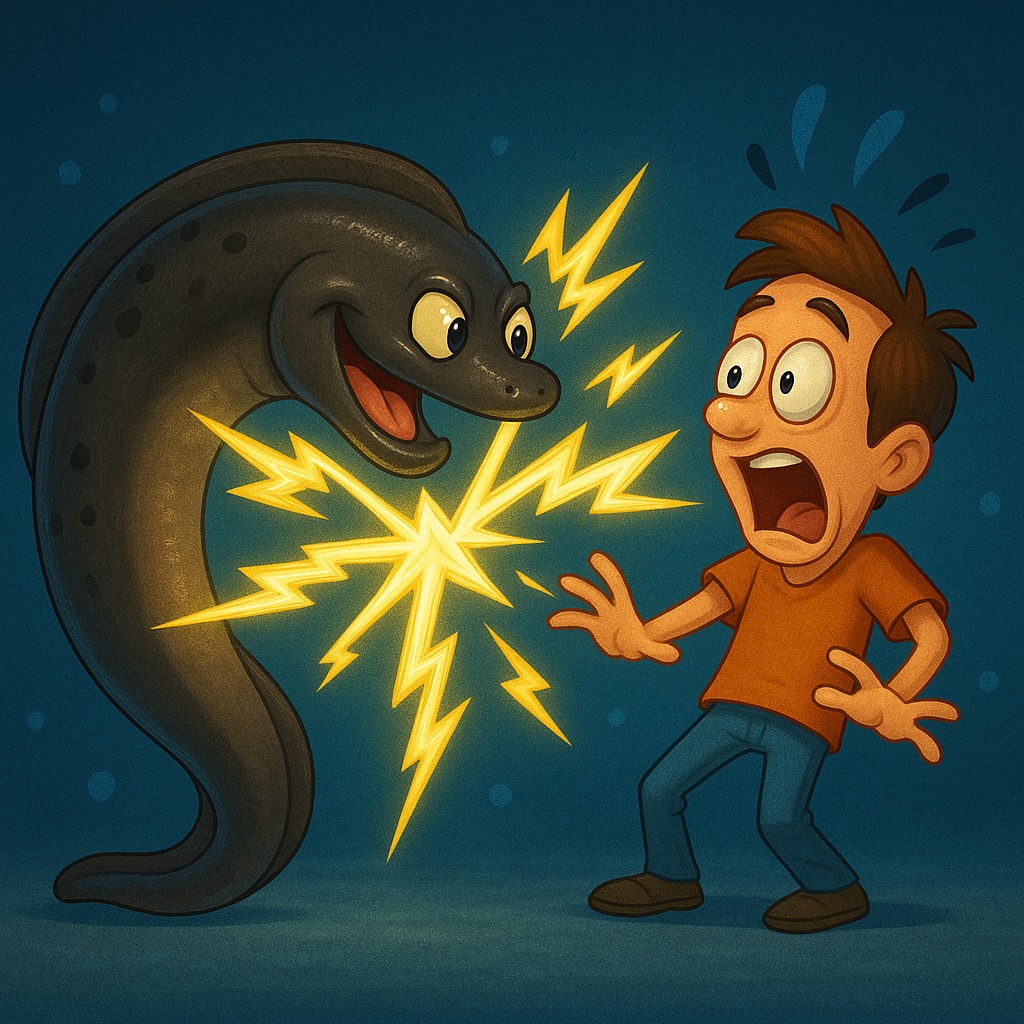
When threatened near the surface, electric eels have been observed partially emerging from the water while maintaining contact with a perceived threat.
This behavior may allow a greater proportion of the electrical discharge to travel through the threat instead of dispersing through the surrounding water.
This is one reason direct contact with an electric eel should never be attempted.
🤝 Cooperative Hunting
One of the most surprising discoveries involving electric eels comes from Electrophorus voltai.
Groups have been observed working together to concentrate schools of small fish.
Several eels may then discharge high-voltage volleys at approximately the same time, stunning multiple prey fish.
This unusual behavior demonstrates that electric eels can be far more behaviorally complex than their solitary reputation suggests.
🗺️ Natural Range
Electric eels occur naturally in South America.
Depending on species, they may be found throughout portions of:
- Amazon Basin
- Orinoco Basin
- Guiana Shield
- Brazilian Shield
- Floodplains
- Tributaries
- Swamps
- Creeks
- Slow-moving river systems
Their habitats often contain warm, slow-moving, muddy, or oxygen-poor water.
🫁 Electric Eels Breathe Air
One of the most important biological facts about electric eels is that they are:
OBLIGATE AIR BREATHERS
They regularly travel to the surface and gulp atmospheric air.
A large portion of their oxygen intake comes from air rather than directly from dissolved oxygen in the water.
Because of this, an electric eel must always have:
- Unobstructed access to the surface
- Adequate air space
- Safe conditions for surfacing
Preventing an electric eel from reaching the surface can be fatal.
🍽️ Diet
Electric eels are predators.
Depending on age and size, their natural diet may include:
- Fish
- Crustaceans
- Aquatic invertebrates
- Amphibians
- Other small aquatic vertebrates
Juveniles may consume smaller invertebrates and similar prey.
Adults are capable of overpowering relatively substantial prey using their electrical discharge.
🌙 Activity
Electric eels are generally most active during:
- Evening
- Night
- Lower-light periods
Their reliance on electrolocation allows them to function effectively even when visibility is extremely poor.
💖 Reproduction
Electric eel reproductive behavior is fascinating.
Males may construct foam nests, and females can produce large numbers of eggs.
The male may remain near the nest and help protect developing eggs and young.
Young electric eels begin producing electrical signals relatively early in life, with electrical output increasing as they grow.
🔬 Why the Shock Works
High-voltage discharges interfere with the nervous and muscular systems of prey.
Rapid electrical pulses can trigger involuntary muscle contractions.
This can temporarily prevent prey from:
- Swimming normally
- Escaping
- Coordinating movement
Repeated volleys may further exhaust or immobilize prey.
The effectiveness of the electrical field also depends on:
- Distance
- Body position
- Water conductivity
- Contact
- Orientation of the eel and target
🧍 Human Safety
Electric eel shocks should always be taken seriously.
Fatal incidents are considered very uncommon, but that does not mean the fish is harmless.
Major risks can include:
- Loss of muscle control
- Falls
- Panic
- Secondary injuries
- Repeated electrical exposure
- Drowning if shocked while in water
People with underlying medical vulnerabilities may face additional risks.
🚨 If Someone Is Shocked
The first priority is to prevent drowning or additional electrical exposure.
If a person experiences a significant electric eel shock:
- Get out of the water safely
- Avoid additional contact with the animal
- Make sure breathing and consciousness are normal
- Seek medical attention if symptoms develop or the shock was significant
Never deliberately test an electric eel's electrical output on yourself or another person.
🧠 Behavior & Communication
Electric eels are more behaviorally sophisticated than their intimidating reputation may suggest.
Their low-voltage electrical signals can play roles in:
- Navigation
- Communication
- Spacing between individuals
- Courtship
- Locating nearby animals
Different electrical patterns can provide information without requiring a full defensive or predatory discharge.
🔋 Electricity Has an Energy Cost
Generating powerful electrical volleys requires energy.
Electric eels therefore do not continuously produce maximum-strength discharges.
Low-voltage signals are sufficient for routine navigation and communication, while high-voltage volleys are generally reserved for situations where greater electrical force is useful.
🏠 Aquarium Care & Ethical Considerations
Electric eels are not appropriate for ordinary home aquariums.
They become extremely large and present specialized safety and husbandry challenges.
Long-term care requires an enclosure designed around:
- Exceptional adult size
- Air-breathing requirements
- Electrical safety
- Escape prevention
- Heavy biological filtration
- Safe feeding procedures
- Staff safety
- Emergency planning
These animals are much better suited to properly equipped public aquariums, research institutions, and highly specialized professional facilities.
⚠️ Never Handle an Electric Eel by Hand
Direct physical handling should be avoided.
A frightened or restrained electric eel may deliver repeated high-voltage discharges.
Professional care should rely on:
- Physical barriers
- Appropriate nonconductive equipment
- Institutional handling protocols
- Multiple trained personnel
- Carefully planned procedures
Never assume that gloves alone make direct contact safe.
🧤 Protective Equipment Is Not Shock-Proof
Water conducts electricity, and ordinary protective gloves should not be treated as electrical insulation against an electric eel.
Specialized facilities may use protective equipment to reduce incidental contact, but safe procedures should always emphasize:
NO DIRECT CONTACT
Physical separation and professional handling procedures are far more important than relying on personal protective equipment.
🔌 Electrical Safety Around the Aquarium
Any large aquarium already requires careful electrical management.
An electric eel enclosure requires even greater attention.
Professional systems should use:
- Properly protected electrical circuits
- GFCI/RCD protection
- Drip loops
- Equipment designed for aquatic environments
- Appropriate grounding and electrical inspection
- Procedures for safely disabling equipment during maintenance
Electrical equipment and water should always be managed with extreme care.
📻 Can You Hear an Electric Eel's Discharge?
Electric eel discharges can be converted into audible or visual signals using specialized equipment.
Educational facilities and researchers sometimes use:
- Electric-fish detectors
- Hydrophones
- Specialized sensing equipment
- Isolated monitoring systems
- LED displays
These demonstrations allow visitors to experience the eel's electrical activity without touching or stressing the animal.
Any measurement system used around an electric eel should be professionally designed, electrically isolated, and appropriate for aquatic research or public-display use.
🔦 Visualizing the Electrical Discharge
Some public aquariums use specialized isolated sensors connected to displays that flash when an electric eel produces a strong discharge.
This can create an impressive educational demonstration while maintaining physical separation between:
- The animal
- Visitors
- Electrical equipment
The goal should always be to observe naturally occurring behavior, not repeatedly provoke the eel into defensive shocks.
🧠 Myth vs. Fact
❌ Myth: Electric eels are true eels.
✅ Fact: They are South American knifefish.
❌ Myth: Electric eels constantly produce maximum-voltage shocks.
✅ Fact: They use different electrical signals for navigation, communication, hunting, and defense.
❌ Myth: Every electric eel shock is fatal to humans.
✅ Fact: Fatal outcomes are extremely uncommon, but serious injury and drowning remain possible.
❌ Myth: Electricity is used only for stunning prey.
✅ Fact: Electric eels also use weak electrical signals for electrolocation and communication.
📐 Electric Eel Numbers at a Glance
- 📏 Typical Large Adult: Approximately 5–6.5 feet
- 📏 Exceptional Maximum: More than 8 feet
- ⚖️ Large Adult Weight: More than 40 pounds
- ⚡ E. electricus: approximately 480 volts
- ⚡ E. varii: approximately 570 volts
- ⚡ E. voltai: up to approximately 860 volts
- 🔋 Electric Cells: Thousands of specialized electrocytes
- 🫁 Breathing: Regular atmospheric air breathing
- ⏳ Potential Lifespan: Approximately 15–20+ years under professional care
🚫 What You Should Never Do
Never:
- Attempt to touch an electric eel
- Attempt to hand-feed one
- Enter an electric eel enclosure
- Intentionally provoke a defensive discharge
- Attempt to demonstrate the shock on yourself
- Assume shallow water makes the animal safe
- Work around a specialized electric eel enclosure without proper procedures
Their electrical abilities should always be treated with respect.
🪪 Legal & Ethical Responsibility
Electric eels are highly specialized animals.
Anyone maintaining them professionally should follow all applicable:
- Wildlife laws
- Ownership restrictions
- Institutional policies
- Animal-care standards
- Occupational safety requirements
Educational demonstrations should prioritize the welfare of the animal and should not repeatedly provoke high-voltage defensive responses for entertainment.
✨ What Makes Electric Eels So Extraordinary?
Few animals combine as many remarkable adaptations as an electric eel.
They can:
- Breathe atmospheric air
- Navigate using electricity
- Communicate through electrical signals
- Detect hidden prey
- Trigger involuntary prey movement
- Deliver powerful high-voltage strikes
- Adapt to dark, muddy, oxygen-poor environments
They are among the most extraordinary examples of biological specialization found in freshwater ecosystems.
🧠 One-Liner
An air-breathing biological battery with a sophisticated sensory system—the electric eel uses electricity to navigate, communicate, hunt, and defend itself, making it one of the most remarkable freshwater fish on Earth.
Powered by Lightspeed
Display prices in:USD