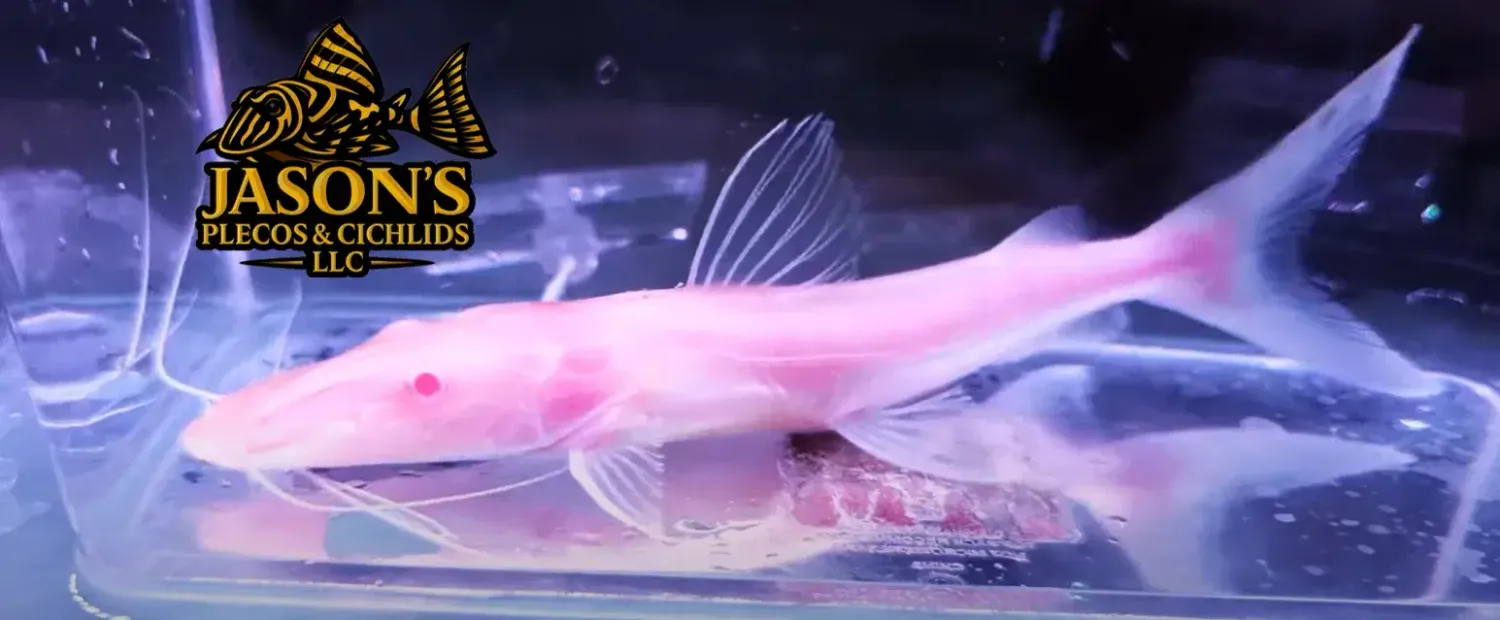
Albino Tiger Shovelnose Catfish - (Pseudoplatystoma fasciatum)
$3 215.00
Captive Bred
was $4 000.00 Save 20%
Size
Required Reusable Shipping Bag
Questions, Comments, Concerns? Let us know!
Enter your text
Price of shipping is not included.
In stock: 1 available
1
Save this fish to my favorites.
Customer reviews
Reviews only from verified customers
No reviews yet. You can buy this product and be the first to leave a review.
Albino Tiger Shovelnose Catfish - (Pseudoplatystoma fasciatum)
Fish Details, Description and Information Below:
🐟 Albino Tiger Shovelnose Catfish – (Pseudoplatystoma fasciatum) – Rare Giant Albino South American Catfish
The Albino Tiger Shovelnose Catfish (Pseudoplatystoma fasciatum) is an exceptionally rare captive-bred color morph of one of South America's most impressive predatory catfish.
Instead of the silver-gray body and bold dark bands normally associated with the species, albino specimens develop striking cream, pale yellow, pinkish-white, or golden coloration with red to pink eyes. Some individuals may retain faint patterning or markings as they grow.
With its long shovel-shaped head, extremely long sensory barbels, streamlined body, powerful predatory feeding response, and extraordinary albino coloration, this is a true collector-quality monster fish.
However, its rarity should never overshadow its adult requirements. Pseudoplatystoma fasciatum is scientifically documented at more than 40 inches in standard length, meaning the tail is not included in that measurement. Adults require an enormous custom aquarium or indoor pond-style system, extremely powerful filtration, and carefully selected tankmates.
This species is recommended only for experienced monster-fish keepers with a realistic long-term housing plan.
🔎 Quick Facts – Albino Tiger Shovelnose Catfish
- 📛 Common Name: Albino Tiger Shovelnose Catfish
- 🔬 Scientific Name: Pseudoplatystoma fasciatum
- 🎨 Color Form: Albino
- 🧬 Stock: Captive Bred
- 🐟 Family: Pimelodidae
- 🌎 Origin of Species: South America
- 🌊 Habitat: Large tropical rivers and seasonally flooded areas
- 📏 Maximum Documented Size: Approximately 105 cm standard length / over 41 inches excluding the tail
- 🏠 Adult Housing: Extremely large custom aquarium or indoor pond-style system
- 📐 Recommended Adult System: Approximately 400–500+ gallons, with substantially larger systems preferred
- 📏 Tank Footprint: Approximately 8–10 feet of swimming length is strongly preferred for a full-grown specimen
- 🌡️ Temperature: Approximately 75–82°F
- 💧 pH: Approximately 6.0–8.0
- 💦 Hardness: Approximately 4–30 dH
- 🍽️ Diet: Carnivore / Piscivore
- 🌙 Activity: Primarily crepuscular to nocturnal
- 😠 Temperament: Predatory; generally not aggressive toward fish too large to swallow
- 🐠 Swimming Area: Bottom / Lower water column
- ⭐ Care Level: Advanced / Expert
- 🏆 Availability: Extremely rare albino color morph
🤍 What Is an Albino Tiger Shovelnose?
The Albino Tiger Shovelnose is a pigmentation morph of:
Pseudoplatystoma fasciatum
It is not a separate species.
Normal-colored Tiger Shovelnose Catfish typically display:
- Silver-gray coloration
- Olive tones
- Dark vertical bars
- Dark blotches
- Spotted fins
Albino individuals may instead display:
- Cream
- White
- Pale yellow
- Golden
- Peach
- Pink coloration
- Red or pink eyes
Depending on the individual and breeding line, faint markings may remain visible.
Exact adult color and pattern cannot be guaranteed because these characteristics may change as the fish matures.
🧬 Important Identification Note
The name Tiger Shovelnose Catfish has been used broadly in the aquarium trade for several members of the genus Pseudoplatystoma.
There are also commercially produced hybrids involving large South American catfish.
For this reason, rare albino specimens should be purchased from a trusted source with known breeder or importer information whenever possible.
This listing identifies the fish as:
Pseudoplatystoma fasciatum
and:
Captive Bred
👃 The Shovel-Shaped Head
One of the most recognizable characteristics of this species is its extremely long, flattened head.
The fish also possesses long sensory barbels that help it locate prey, particularly under low-light conditions.
These barbels function as highly sensitive sensory structures and should never be:
- Pulled
- Cut
- Handled unnecessarily
- Allowed to repeatedly rub against abrasive décor
A properly sized aquarium should provide open areas so the fish can move without constantly striking its head or barbels against decorations.
📏 Adult Size – A True Monster Fish
This is one of the most important sections of the entire product listing.
FishBase documents Pseudoplatystoma fasciatum reaching approximately:
105 cm standard length
That equals roughly:
41 inches before the tail fin is included
FishBase also lists a published maximum weight of:
70 kg / approximately 154 pounds
although aquarium specimens should not be assumed to reach maximum wild weight.
Plan for More Than Three Feet
For aquarium planning, customers should consider this a fish capable of becoming:
3–4+ feet long
rather than treating 30 or 36 inches as a guaranteed maximum.
🚨 Do Not Purchase Based on Juvenile Size
This is especially important because Albino Tiger Shovelnose Catfish may be sold as juveniles only a few inches long.
A 6-inch juvenile can look manageable.
A full-grown specimen is an entirely different animal.
Before purchasing, the keeper should already have a realistic plan for:
- Adult aquarium dimensions
- Filtration
- Water changes
- Food costs
- Tankmates
- Moving the fish
- Long-term housing
Do not purchase one with the expectation that you will simply “upgrade later” without already understanding what that upgrade requires.
🏠 Adult Aquarium Size
For an adult Tiger Shovelnose, aquarium dimensions are more important than gallon count alone.
A practical long-term system should be approximately:
400–500+ gallons
with substantially larger systems strongly preferred.
For maximum-sized adults, a:
- Custom aquarium
- Indoor pond
- Large monster-fish system
may be considerably more appropriate than a conventional glass aquarium.
Recommended Footprint
For a large adult, think in terms of roughly:
8–10 feet of aquarium length
with substantial front-to-back width.
Large-catfish husbandry references similarly recommend extremely long, wide systems rather than conventional aquariums.
📐 Width Matters
A 500-gallon aquarium that is too narrow can still be inappropriate.
The fish must have enough room to:
- Turn comfortably
- Swim without rubbing its barbels
- Accelerate without immediately striking glass
- Rest naturally
- Feed without being cramped
These are long, powerful river fish.
A tall aquarium does not compensate for inadequate length or width.
⚠️ Prevent Head & Snout Injuries
Tiger Shovelnose Catfish can move extremely quickly when frightened.
A startled large individual may suddenly accelerate across the aquarium.
This creates a risk of:
- Damaged snout
- Injured barbels
- Abrasions
- Impact injuries
Avoid overcrowding the aquarium with hard decorations.
Maintain:
Large, unobstructed swimming lanes
Decorations should be positioned primarily around the edges and rear of the aquarium.
🏠 Aquarium Setup
Recommended features include:
- Fine sand or smooth substrate
- Large open swimming areas
- Large pieces of driftwood
- Shaded areas
- Smooth rocks
- Large protected resting areas
- Powerful filtration
- Strong oxygenation
- Moderate water movement
- Secure aquarium covers
Avoid:
- Sharp rocks
- Tight caves
- Rough décor
- Narrow gaps
- Unsecured structures
Anything placed in the aquarium should be appropriate for a powerful fish potentially exceeding 3 feet.
💩 Extremely Heavy Bioload
Large Tiger Shovelnose Catfish produce a substantial amount of waste.
As adults they consume large meals and require exceptional filtration.
Recommended filtration may include:
- Large sump systems
- Oversized mechanical filtration
- Large biological chambers
- High-flow pumps
- Easy-to-clean prefilters
- Strong surface agitation
Maintain:
- ☠️ Ammonia: 0 ppm
- ☠️ Nitrite: 0 ppm
- 🔄 Nitrate: As low as reasonably possible
- 💨 Oxygenation: High
Regular large water changes should be expected.
💧 Water Parameters
FishBase reports the following environmental range for Pseudoplatystoma fasciatum:
- 🌡️ Temperature: 24–28°C / approximately 75–82°F
- 💧 pH: 6.0–8.0
- 💦 Hardness: 4–30 dH
- 🌊 Water Type: Freshwater
For aquarium maintenance, I recommend:
- 🌡️ Temperature: 75–82°F
- 💧 pH: 6.0–7.5
- 💦 Water: Soft to moderately mineralized freshwater
- 💨 Oxygen: High
- ☠️ Ammonia: 0
- ☠️ Nitrite: 0
Stable, clean water is more important than constantly adjusting the aquarium to reach one exact pH.
🌎 Natural Habitat
Pseudoplatystoma fasciatum is a large South American river catfish.
FishBase reports it from major South American drainage systems including the:
- Amazon
- Corantijn
- Essequibo
- Orinoco
- Paraná
Adults inhabit major river channels and may also enter seasonally flooded forest areas.
They appear particularly associated with riverbeds and shaded aquatic environments.
🌙 Nocturnal Predator
Wild Pseudoplatystoma fasciatum are primarily active predators during lower-light periods.
FishBase reports feeding on:
- Loricariid catfish
- Cichlids
- Characins
- Crabs
with much of the foraging occurring at night along the river bottom.
Their:
- Long barbels
- Large mouth
- Streamlined body
- Sensory abilities
make them extremely effective predators.
🍽️ Diet & Feeding
The Albino Tiger Shovelnose is a carnivorous predator.
Recommended foods include:
- Shrimp
- Prawns
- Krill
- Mussels
- Clams
- Squid
- Pieces of fish fillet
- Large carnivore pellets
- Quality catfish pellets
- Other appropriate frozen or fresh aquatic foods
Juveniles should receive appropriately sized portions.
Adults should receive larger meals less frequently rather than being constantly overfed.
🚫 Avoid Routine Feeder Fish
We do not recommend routinely feeding live feeder fish.
Feeder fish can introduce:
- Parasites
- Bacterial disease
- Viral disease
- Nutritional deficiencies
Tiger Shovelnose Catfish can generally be conditioned to accept:
- Frozen foods
- Fresh seafood
- Pellets
- Prepared carnivore diets
This gives the keeper much better control over nutrition and disease exposure.
🚫 Avoid Mammal & Poultry Meat
Foods such as:
- Beef
- Pork
- Chicken
- Beef heart
should not form a regular part of the diet.
These foods contain fats and tissues that freshwater predatory fish are not naturally adapted to consuming in large amounts.
Aquatic animal proteins are a much better long-term choice.
😠 Temperament
Tiger Shovelnose Catfish are primarily dangerous to other fish because of predation rather than territorial aggression.
They possess an enormous mouth.
If another fish can fit inside that mouth:
Assume it may eventually be eaten.
A fish that is safe with a juvenile Tiger Shovelnose may become prey several months later as the catfish grows.
🐠 Tankmates
Potential tankmates in an enormous aquarium may include:
- Large Peacock Bass
- Large South American cichlids
- Large Arowanas
- Large Datnoids
- Large Bichirs
- Large Plecos
- Other giant catfish
- Other robust monster fish too large to swallow
Compatibility can never be guaranteed.
Avoid:
- Small cichlids
- Tetras
- Small plecos
- Small catfish
- Goldfish
- Small bichirs
- Small community fish
- Any fish narrow enough to fit inside the mouth
⚠️ Body Shape Matters With Tankmates
Do not judge prey size only by length.
A long, narrow fish may still fit inside a Tiger Shovelnose's mouth even when it appears surprisingly large.
Always consider:
- Body depth
- Body width
- Head size
- Mouth size
when selecting tankmates.
👥 Keeping Multiple Tiger Shovelnose Catfish
Multiple specimens can sometimes coexist when:
- The enclosure is enormous
- The fish are similarly sized
- Food is distributed properly
- Adequate swimming room is provided
However, keeping multiple adults dramatically increases:
- Required tank volume
- Waste production
- Food requirements
- Filtration requirements
A system suitable for one adult should not automatically be considered large enough for two.
♂️ Male vs. Female
There is no simple, reliable method for externally sexing juvenile Tiger Shovelnose Catfish.
Mature females may become heavier-bodied than males, particularly when reproductively mature.
However, customers should not expect reliable visual sexing of small aquarium specimens.
Unless sex has been determined through a reliable method, fish should be sold as:
Unsexed
🥚 Breeding
Breeding Pseudoplatystoma fasciatum is not considered practical in the typical home aquarium.
The species is:
- Large
- Riverine
- Migratory
- Highly fecund
- Dependent on environmental reproductive cues
FishBase reports females becoming sexually mature at approximately 56 cm and males around 45 cm.
Commercial propagation of large pimelodid catfish generally requires specialized facilities.
For the normal home aquarist, this should be considered a display species rather than a realistic breeding project.
🧬 Albino vs. Hybrid
Because Tiger Shovelnose Catfish are commonly hybridized in commercial aquaculture, customers should understand that:
Albino does not automatically mean pure species.
Albino describes coloration.
It does not establish genetic identity by itself.
Known hybrids exist between large South American catfish, including Tiger Shovelnose-type fish and Redtail Catfish.
For rare collector specimens, known breeder lineage is valuable.
This listing identifies the animal as a captive-bred:
Albino Pseudoplatystoma fasciatum
⭐ Why Keep an Albino Tiger Shovelnose?
For a properly equipped monster-fish keeper, this is an extraordinary collector fish.
Its combination of:
- 🤍 Extremely rare albino coloration
- 👁️ Red or pink eyes
- 👃 Long shovel-shaped head
- 🧔 Extremely long sensory barbels
- 📏 Giant adult size
- 🍽️ Powerful predatory feeding behavior
- 🌎 South American river origin
- 🧬 Captive-bred availability
- 🏆 Exceptional rarity
makes the Albino Tiger Shovelnose one of the most striking giant catfish available in the aquarium hobby.
However, this fish should be purchased because the keeper can provide for the adult animal, not simply because the juvenile is rare.
⚠️ Important Considerations
Before purchasing an Albino Tiger Shovelnose Catfish:
- Plan for a fish potentially exceeding 3½ feet.
- Do not purchase based on juvenile size.
- Plan for approximately 400–500+ gallons as the fish matures.
- Larger custom systems or indoor ponds are preferred.
- Prioritize aquarium length and width.
- Maintain large open swimming lanes.
- Avoid sharp decorations.
- Use exceptionally strong filtration.
- Maintain high oxygen levels.
- Perform regular large water changes.
- Feed a varied carnivorous diet.
- Avoid routine feeder fish.
- Avoid mammalian and poultry meat as staple foods.
- Do not house with fish small enough to swallow.
- Understand that albino coloration does not by itself prove genetic purity.
- Never release this fish into local waterways.
This species is recommended for advanced or expert monster-fish keepers only.
🚨 Invasive & Legal Considerations
Large nonnative predatory fish may be restricted in certain states or local jurisdictions.
Customers are responsible for confirming whether this species may legally be:
- Purchased
- Possessed
- Imported
- Transported
- Received
at the destination.
Never assume that because a fish is legal in one state it is legal in every state.
🚚 Live Fish Shipping
Live fish are professionally packed for safe transport.
Shipping availability depends on:
- Fish size
- Destination
- Weather
- Carrier availability
- Applicable state and local regulations
Larger specimens may require:
- Oversized insulated boxes
- Additional water
- Specialized bags
- Specialized handling
- Airline cargo shipment
Please review our Shipping & Payment Information and Live Arrival Guarantee / DOA Policy before ordering.
⚠️ Buyer Responsibility
Customers are responsible for confirming that this species may legally be purchased, possessed, transported, and received in their state or local jurisdiction before ordering.
Never release aquarium fish into local waterways.
Powered by Lightspeed
Display prices in:USD